
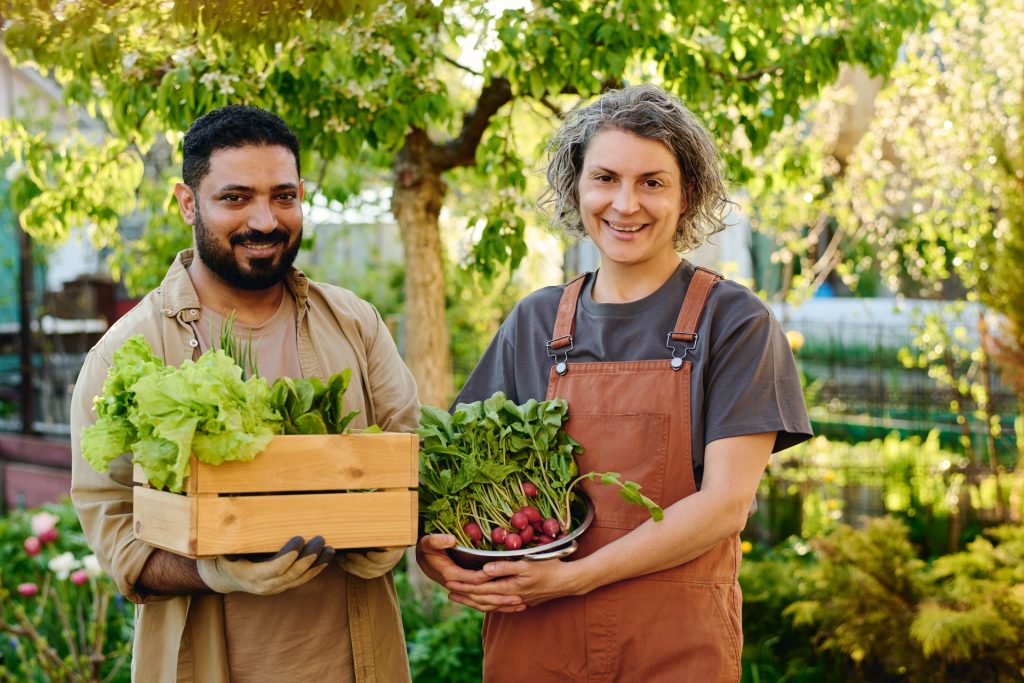

A revolution is taking place in gardening across America. Even casual research reveals the dynamic growth, in number and popularity, of YouTube programs featuring what has come to be called “The Big Four”: organic gardening, biodynamics, regenerative agriculture, and permaculture.
Interest in these practices, and specialized offshoots such as syntropic agroforestry, has marched boldly into the 21st century. Hundreds of eager beavers in overalls are out there on homespun podcasts, trying to convince you that this widespread food-growing commitment is not just a passing fad.
They range from excited personalities displaying their latest and often quite clever backyard innovations, to large, productive gardening projects that combine traditional methods with scientific, tech-oriented improvements.
This burgeoning private gardening milieu is now delivering a kind of Wild West extravaganza on the internet—and “awake” consumers are reaping the benefits.

Precedents that reward aspiring gardeners
Extolling our modern advancements in gardening is not to disparage the arduous work of our ancestors, even going back to ancient times.
Agricultural toil has surely been the primary human occupation since the days human bipeds realized that the plants they were consuming could be reproduced at will—though likely at first with an almost accidental intervention.
If we compare the sweat and toil of the garden plots from our grandparents’ time to the far more productive, generally more healthful, and comparatively greater ease in present-day gardening, well, the difference is extraordinary.
Let’s explore what this innovative cornucopia promises for our collective future—especially in the realm of permaculture.

What is permaculture and why is it important?
“Permaculture” as a gardening practice arose, broadly speaking, in the 1960s, before a formal name was conferred upon the phenomenon. In 1974, two Australian, green- thumb academics, Bill Mollison and David Holmgren, filled that terminology vacuum.
They blended the terms “permanent” and “agriculture” to define this fledgling trend in the gardening world.
Their contribution to permaculture was to define it as a sustainable growing practice in harmony with nature. This approach centered on applying multiple water conservation methods and natural fertilizers, along with specific methods for soil bacteria enrichment and diverse weed-retarding measures.
Meanwhile, these perma-devotees avoid soil tillage and its concomitant nitrogen depletion, while simultaneously employing newer approaches to mulching with a variety of highly beneficial “soil covering mechanisms.”
In the present day, the skies are blue in permaculture land. Permacultural enthusiasts, along with their Big Four “partners,” are counteracting the increasingly negative impacts of industrial agriculture.
They challenge Big Ag by demonstrating that, over time, the highly toxic, moisture- and soil-depleting mass production utilized by these multinational corporations is wreaking havoc upon the health and well-being of millions of innocent, uninformed consumers—and that it can be replaced by healthier, more holistic practices that respect and replenish the soil.
Are these innovations unique to permaculture?
Not at all! Similar and even identical initiatives are implemented within the other food gardening practices. However, there seems to be at least some indication that the permaculture movement is a leading gardening innovator.
For example, Google Trends shows that permaculture gardening is one of the most commonly searched gardening techniques in 2024.
Exploring specific permaculture innovations
With rising food prices and concerns about food security due to changing climate conditions, society is fast approaching a time when families and individuals may need to obtain their sustenance in their local neighborhood, if not right in their own backyard.
What follows here are particular gardening practices—either new or newly improved—that are boosting yields while reducing the time and toil expended.
1. Raised beds: making home gardening easier and more productive
You can jump online to encounter a wonderful variety of soil-filled “beds” that flourish on permaculture operations, deploying a surprising variety of construction materials.
The crops grown within these well-above-ground, usually rectangular structures reward the user with increased production in what is often a remarkably confined growing space.

Such raised structures also reduce aches, pains, and injuries for human backs. This is not merely because of the elevated, “posture enhancing” workspace, but because the beds make the tasks of watering, weeding, and pest control even easier than in a “normal” permaculture layout.
Here we give honorable mention to another sort of raised bed, namely, vertical planters. These are tall columnar or barrel-like structures that easily become home to an abundant crop. This is good news for perma-devotees and other would-be gardeners laboring on small plots and in tight spaces!

2. Straw bales: modest but effective water-conserving planters
Straw bales may not be an overall panacea but, particularly for novice suburban gardeners, they have become a welcome innovation.
Straw in bale form is ubiquitous and cheaply priced. As a ready-to-go planter, the bales pose several advantages.

Straw bales excel at retaining moisture, yet are nevertheless well-aerated. They gradually decompose over a growing season, whereupon the straw, left in place, becomes an excellent mulch. As a bonus, the leftover straw also serves as a great addition to your compost heap!
Of course, not every vegetable is comfortable in a straw-bale environment. However, virtually all leafy greens, numerous herbs, root veggies such as carrots, beets and radishes, and several squashes and tomato varieties, are known to thrive in a straw habitat.
To be fair, there are some straw-bale challenges as well. For example, there may be weeds in the straw, so it’s best to opt for somewhat more expensive, weed-free bales. To boot, there are conditioning treatments that “straw veterans” recommend before you implant the bales with your seedlings.
The bales require a certain amount of preparation time and possibly some extra perspiration, given their weight—depending on whether the baler is a muscular Paul Bunyon type or a denizen of the living room couch.
After one season of straw baling, most gardeners are either committed advocates or move on to other planting strategies. In any case, these straw cubicles have won their fair share of gardening enthusiasts.
3. Wicking beds: Ingenious systems for water control
From its earliest appearance, permaculture has placed a premium on moisture control by applying techniques designed for diverting, capturing, securing, and otherwise sensibly retaining the water resources on a given property.
That’s where wicking beds come in. These ingenious garden beds are designed for maximum moisture control, which is accomplished by watering the roots from below rather than from above the soil.

Some early proponents of what might be called wicking bed precursors, in particular Zimbabwean Allan Savory, have demonstrated that a well-thought-through moisture control approach is capable of transforming a barren desert landscape into a productive green habitat.
Savory’s work became widely known and inspired the wicking bed movement in arid or drought-prone regions.
Wicking beds are truly conservation-friendly by greatly reducing solar evaporation and using barely more than the exact amount of water needed for the plant to thrive—a big deal in severely water-depressed areas.
In places like Arizona and the Southwestern US in general, all that time spent out in your garden creating wicking beds can pay off big time: it can make the difference between a headache and a harvest.
How difficult is it to install this “water repository?”
The objective of using wicking beds is to ensure a steady and easily calibrated supply of moisture to a variety of vegetables that have a short to medium root system. As to the difficulty, experienced users will respond, “Not very!”
There is an initial, fairly modest investment of labor and expenses to get the beds situated. But permaculturists facing a regularly or periodically parched landscape are usually more than pleased with the resulting bounties.
The materials involved are hardly exotic. What would-be gardener doesn’t have access to a ready supply of gravel, clay balls or pebbles and, of course, soil for planting? With the addition of a single layer of geomatting, derived from biodegradable fibers like coconut coir or synthetic materials like polypropylene, intrepid drylanders are good to go.
The cost of the matting is not prohibitive and ordinarily pays for itself in its debut season. Several online podcasters will proudly walk you through the process of installing them—free of charge!
Of course, plants with deep root systems can’t thrive on top of a wicking bed. But don’t despair. These underground basins can produce tomatoes, several types of lettuce as well as most leafy greens, and several of your favorite herbs, not to mention peppers, carrots, cucumbers, some squashes, and a variety of beans.
4. Cold weather challenges: from foe to friend
In the northerly latitudes, lots of aspiring four-season gardeners are erecting greenhouses that capture below-frost line temperatures year-round.
The essential concept is to construct the greenhouse over a small underground area that’s excavated just beneath the local frost line, combined with installing a modest amount of PVC tubing to tap the underground airflow.

This method draws into the greenhouse the warm ground air—circa 50 degrees Fahrenheit in the colder months—which greatly extends the growth cycle of the plant life inside. Happily, that same 50-degree air also keeps the greenhouse plant life cooler during the intense heat of summer.
With a small fan and a louvered window or two for calibrated hot or cold air regulation, greenhouse devotees have a big winner on their hands. Truly, the abundance generated by these modified structures makes the extra effort and expense an afterthought.
5. Walipinis: rewarding gardeners in the harshest climates
The walipini greenhouse model is even more hardcore and combat-ready than the more common but less fortified conservatory described above. “Walipini” means “place of warmth in the Aymara language of the Andes, where this greenhouse type originates.
A properly constructed walipini is a highly insulated, earth-bermed structure, except for its carefully slanted, southerly facing, transparent roof cover.

The number of walipini enthusiasts is steadily growing. This cold-climate innovation is now becoming a common sight in extreme weather localities, since it provides nearly year-round sustenance for folks with the initiative to install them.
6. Electroculture: the revival of centuries-old copper magic
From the electroculture world comes the copper wire growth stimulator. These modest devices actually arose among astute, science-inspired gardeners in the 1700s (with kudos to the multi-talented experimenter Benjamin Franklin).
In that bygone period, experiments with copper wire led to using it successfully in coaxing growth from various vegetables.
Copper stimulators are back today in modern form. The method is simple: copper wires or rods are inserted into the soil around the plants. Electroculture gardeners believe that these wires conduct atmospheric electricity into the soil, which in turn is believed to stimulate root growth.

According to users of these devices, gardeners employing them correctly can expect a reduction in insect invasion, robust plant sizes, more prolific plant production, and harvested produce that keeps longer in storage.
Good things are happening in permaculture
In closing, we’ll briefly mention some additional innovations that modern-day permaculturists are engaged in.
Making a splash are new, biodegradable mulching materials, and, thanks to ever-advancing science in this digital age, an array of newly discovered, non-toxic pesticides and herbicides.
Also worth mentioning are a couple of big-time producers named aquaculture and hydroponics. These two are more than capable of producing great food abundance—so much so that numerous permaculturists are incorporating them into their existing gardening operations.
We are without a doubt in a new era of, dare we say, revolutionary gardening. With it comes a cautious optimism that these innovative practices can feed people everywhere in the changing times ahead.

Leave a Reply