
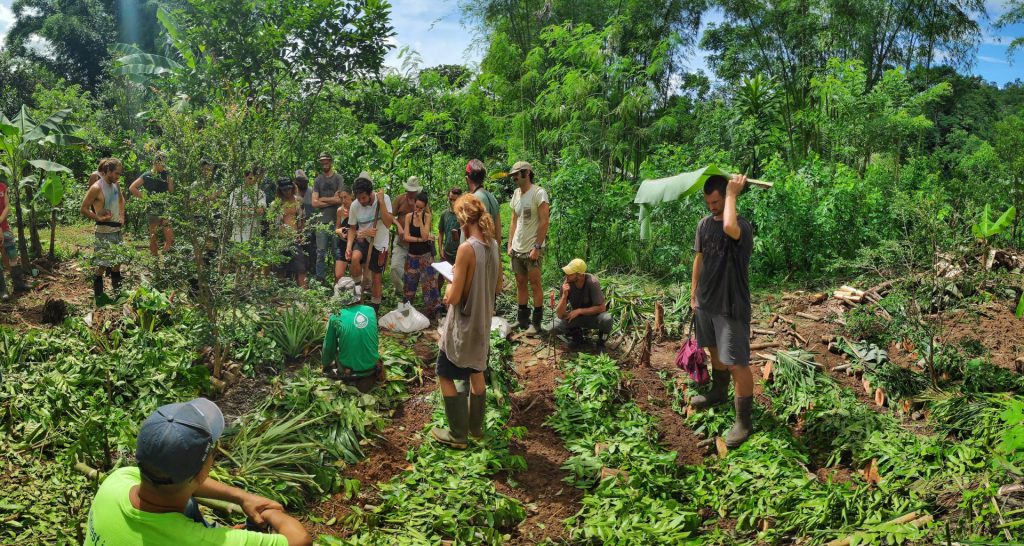

Imagine a barren hillside transformed into a lush, thriving forest of bananas, cherimoyas, taro, and native trees—all growing in harmony and producing food for both people and wildlife.
That’s the power of syntropic agroforestry, a regenerative agriculture method that’s best described as an ingenious partnership with nature. The idea is to harness and accelerate nature’s own processes to heal degraded land and create rich ecosystems.
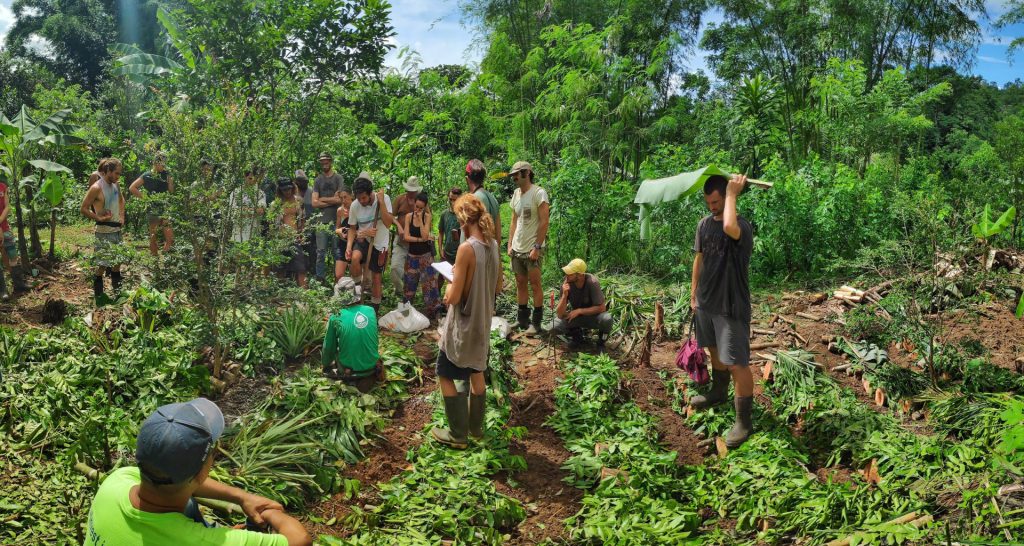
Syntropic agroforestry is a subset of its parent philosophy, syntropic farming. Pioneered by Ernst Götsch in Brazil during the 1980s, this unique farming approach mimics the way natural forests grow and sustain themselves.
By combining high plant density with a variety of species and strategic pruning, farmers create self-sustaining cycles that enrich the soil, improve water retention, and produce abundant crops.
This system works in any climate. It offers a powerful solution to some of today’s most pressing agricultural challenges.
In New Zealand’s Northland, the Lotz-Keegan family’s PermaDynamics farm beautifully demonstrates this method’s potential. Located on steep, marginal land once used for sheep grazing, their small-acreage food forest now supports 100-plus families with fresh, organic produce.
Through careful planning and a light touch with the land, the family has created a system that thrives year after year. “Our role is to be a partner in nature’s dynamic process,” PermaDynamics’ Klaus Lotz said in a 2021 feature film about the farm.
His daughter Frida Lotz-Keegan added a statement that gets to the heart of what syntropic agroforestry is all about: “Nature wants to evolve,” she said. “We’re simply accelerating that process in a way that enhances its fullest expression.”
Meticulously managed “food forests” like the one at PermaDynamics are proving that even the most unyielding terrain can provide a continuous bounty of food.
A bit of terminology
Before we dive into the PermaDynamics playbook to find out how the Lotz-Keegan family created and now manages their unique farm, let’s define a few terms.

What is agroforestry?
Agroforestry is a broad umbrella term that refers to the “cultivation and use of trees and shrubs with crops and livestock in sustainable agricultural systems,” according to Brittanica.com. “Agroforestry seeks positive interactions between its components, aiming to achieve a more ecologicallydiverse and socially productive output from the land than is possible through conventional agriculture.”
What is syntropic agroforestry?
Syntropic agroforestry, a subset of agroforestry, is a food production system designed to mimic how a natural forest works. By recreating the diversity of a forest, it creates resilient ecosystems that provide food while regenerating the land. This approach blends agriculture and ecology into one dynamic process.
A key principle of syntropic agroforestry is guiding the land through stages of natural succession. What does this mean, in plain language?
In nature, bare land gradually transforms into a forest in stages, each building on the previous one. Syntropic agroforestry speeds up this process by using simple techniques like planting fast-growing species to cover the soil, pruning plants to produce organic mulch, and layering crops in ways that mimic a forest structure.
These practices create a rich soil. They encourage biodiversity and establish a self-sustaining ecosystem that needs significantly less tending once it is established.
What is syntropic farming (or syntropic agriculture)?
There is no easy-to-understand definition of syntropic farming, according to author and Ernst Götsch disciple Dayana Andrade. First and foremost, syntropic farming is “a change in perspective,” she writes. “It’s a new proposal for reading the ecosystem which enables the farmer to seek his/her answers using another reasoning quite different from what we’re used to.
“In syntropic farming, holes become nests, seeds become genes, weeding becomes harvesting…competition gives way to cooperation and pests and diseases are seen as the ‘agents from the department of optimization of life processes,’” Andrade explains. “These and other terms do not arise by chance, but rather derive from a change in the way we see, interpret and relate to nature.”
Most sustainable farming methods swap out environmentally harmful materials for eco-friendly alternatives. For example, chemical fertilizers are often replaced by organic fertilizers, plastics with biodegradable materials, and synthetic pesticides with natural remedies.
But the mindset behind these methods is still similar to conventional farming: growers are mostly trying to fix, through material applications, problems caused by poor growing conditions.
Syntropic agriculture takes a different approach. Instead of just adding more eco-friendly material additives to soils and plants, it focuses on mimicking and speeding up how nature works.
Farmers who employ syntropic farming principles carefully organize plants to match their ideal growing conditions. They place them in precise spots (in different layers, such as how they grow in a forest) and plant them at times that follow natural growth cycles.
“It is process-based agriculture, rather than input-based,” Andrade notes. She adds that in this way, growing food becomes a natural side effect of restoring the ecosystem. The reverse is also true: restoring the ecosystem naturally leads to better harvests.
What are food forests?
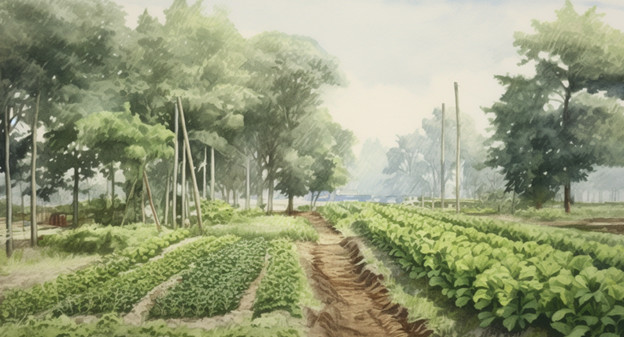
A food forest is a garden designed to work like a natural forest. Layers of trees, shrubs, and plants grow together and support each other. It’s a self-sustaining system that produces fruits, nuts, vegetables, and herbs while improving the soil and helping nature thrive.
Are all food forests syntropic?
No, “food forest” is a more general term and does not necessarily imply the use of syntropic farming principles. Here’s the distinction:
A food forest is a design concept inspired by natural forests. Its goal is to create self-sustaining ecosystems that produce food. It typically incorporates multiple layers of vegetation, from canopy trees to ground covers, with an emphasis on perennial species.
While food forests align with principles of regeneration and biodiversity, they do not inherently follow the detailed methodologies of syntropic farming.
Food forests can use syntropic farming principles, such as plant stratification, natural succession, and high biodiversity, but this is not a requirement. It is also worth noting that many food forests are designed using permaculture principles, which overlap with but are not identical to syntropic farming.
The creation of the Lotz-Keegan farm in New Zealand
Now that we’re clear on the definitions, let’s revisit the Lotz-Keegan farm.
When the Lotz-Keegan family moved from South America to New Zealand, they brought with them a wealth of knowledge about syntropic farming and permaculture. This specialized knowledge helped them to transform their new property, once considered marginal land, into a thriving food forest.
What they brought to the project
The farming family didn’t have to start from scratch, inventing every step of the way. Here’s what they were able to plow into their new project:
- Hands-on experience: PermaDynamics patriarch Klaus Lotz had the good fortune to work with syntropic farming guru Ernst Götsch during the creation of Götsch’s original syntropic farm in Bahia, Brazil. This gave him an understanding of how to use plant diversity and natural succession to improve soil health and grow food.
Klaus: “I’ve never come across anything as effective as syntropy to revitalize depleted soils and to produce food at the same time as increasing wildlife and soil fertility.”
- A partnership with nature: The family members work alongside nature’s processes to help the land regenerate and reach its full potential. They emphasize observing and cooperating with the ecosystem instead of trying to control it.
Frida: “At the heart of it, it’s really about slowing down. It’s about observing before interacting. It’s about following the fundamental principles of nature.”
Klaus loves to walk out into the forest and just sit and soak in his agroforest surroundings. “I don’t like to see myself as a steward of the land, more like a partner in the development of the highest expression of life that we can see in this particular spot,” he says.
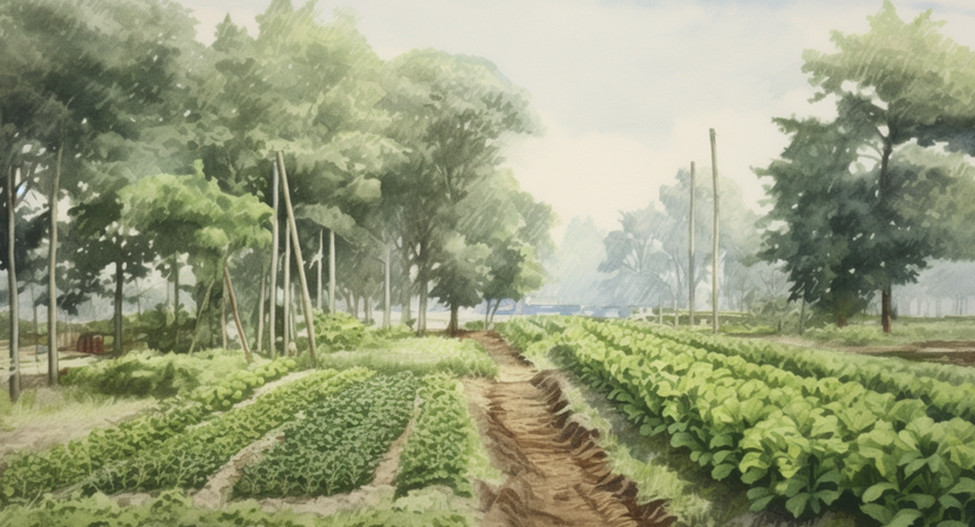
- A multifaceted approach: By combining syntropic farming with permaculture practices, they have integrated other activities like growing vegetables, raising livestock, and building with earth.
For example, they plant nitrogen-fixing trees like inga or acacia alongside fruit-bearing species such as avocado, mango, and papaya. The nitrogen fixers improve soil fertility by releasing essential nutrients. In between these trees, they grow vegetables like kale, squash, and beans in carefully timed rotations.
This layered system minimizes plant competition and maximizes yields, which are hallmarks of syntropic farming.
Livestock integration further enhances this balance. Chickens, for instance, scratch up the soil and eat pests while fertilizing the ground with their manure.
Meanwhile, earth-building practices—such as constructing cob storage sheds and rainwater harvesting tanks—create infrastructure that reflects the same regenerative ethos. These practical earthen structures blend seamlessly into the environment.
Frida: “I enjoy the variety. I enjoy that there’s never a boring moment on the farm. It’s always different and that’s much due to it not only being a syntropic agroforestry farm. That’s where the other element of our farm, which is the permaculture side, comes through. We have goats. We make sauerkraut. We have a market garden. We ride horses. We do earth building.”
How they created a successful farm business
The family’s success also built on the following practices:
- Accelerating nature’s work: They designed their food forest to mimic natural forests. However, they also sped up the process. They planted many different species close together, beginning with fast-growing pioneer plants. Over time, they have added a variety of crops that produce yields over months, years, and even decades.
Frida explains: “You could leave a hillside to naturally turn into a food forest or a forest, but that would take hundreds of years to do naturally. With syntropic agroforestry we can accelerate that in a natural way…to work with that natural drive of nature to actually bring it into its highest state, into its fullest expression of potential that it has, much faster when we see ourselves as a positive member of this ecosystem.”
- Using support plants: They have introduced “helper plants” that grow quickly and respond well to pruning. Cutting back these plants regularly adds organic matter to the soil, keeps it moist, and releases growth hormones that benefit surrounding crops.
Klaus: “As we prune these plants, they want to grow back strongly. And when the plant is strongly growing back, it releases hormones into the soil that drive other plants to a higher production as well.
“So the whole system starts humming when you have these helper plants releasing these regrowth hormones into the soil where they get distributed by a fungal network and all the neighboring plants join in on that, including your crops.
“They do better, they become healthier. Also, the pruning activates defenses in the plants against pests and diseases and feeds the soil life with all the sugars that they can pump in because therefore the synthesis is stronger.
“The support species we select can be a mix of native plants and exotic plants. Whatever plant thrives here and does exceptionally well and handles heavy pruning, frequent pruning, several prunings per year, those are the plants we are looking for.”
- Improving the soil: During the initial phase of the farm, the family added compost, biochar, and other amendments to jump-start soil fertility. Over time, pruning and mulching have built rich, carbon-heavy soil that supports healthy crops and a vibrant ecosystem.
- Boosting plant resilience: Dense planting creates a self-sustaining system. The mix of crops and support plants protects against pests and diseases naturally, without the need for sprays or chemicals. The thick organic layers, including mulch from pruning, help retain water, which reduces the impact of dry spells.
Klaus: “The more diversity we have, the more likely each species can find a niche, and the overall production of biomass and food produced will be much higher than if we have reduced diversity or monoculture.”
- Involving the community: The family invited friends and neighbors to help plant the food forest and taught their helpers along the way.
Frida: “When we implemented this system, we had 20-plus people here: friends, family, uncles, aunties, kuya, kids. We did it all together and that’s what was really special.”
The symphony of a syntropic agroforest
Klaus goes into detail to illustrate how and why his family’s syntropic agroforest has become a complementary symphony of nature at work.
“We’re not only having an orchard, we’re not only having an annual vegetable garden,” he explains. “We’re combining all the different plants so that throughout time and space they grow and evolve and we’re working with that dynamic of nature.
“In this particular site, it’s an alluvial flat land and it’s temperate climate so we do get frost here in winter. So the plants that we choose are very much in line with what can grow here.
“Also because we’re integrating it within a market garden we want to allow the distances between the syntropic food forest rows to accommodate these vegetable rows within.
“So having these perennial syntropic beds within the market garden allows the soil in those beds to rest and really develop in a really complex form that’s resetting annual beds even in a no-dig situation.”
This method sharply contrasts with traditional farming practices, he points out. “Resetting nature to be just in annuals is setting nature back, holding it back. Nature wants to evolve, it wants to become a forest, it wants to then form a forest, a tree falls over and it has annuals again, it wants to constantly evolve.”
Combining food production with land regeneration
Today, the farm produces enough food to feed the Lotz-Keegan family and more than 100 other families. Their work shows how degraded land can become a rich, productive ecosystem when people actively work with nature instead of against it.
They’ve created a model that combines food production with ecological restoration—and a lifestyle that’s both community-oriented and rewarding for the whole family.

Leave a Reply