
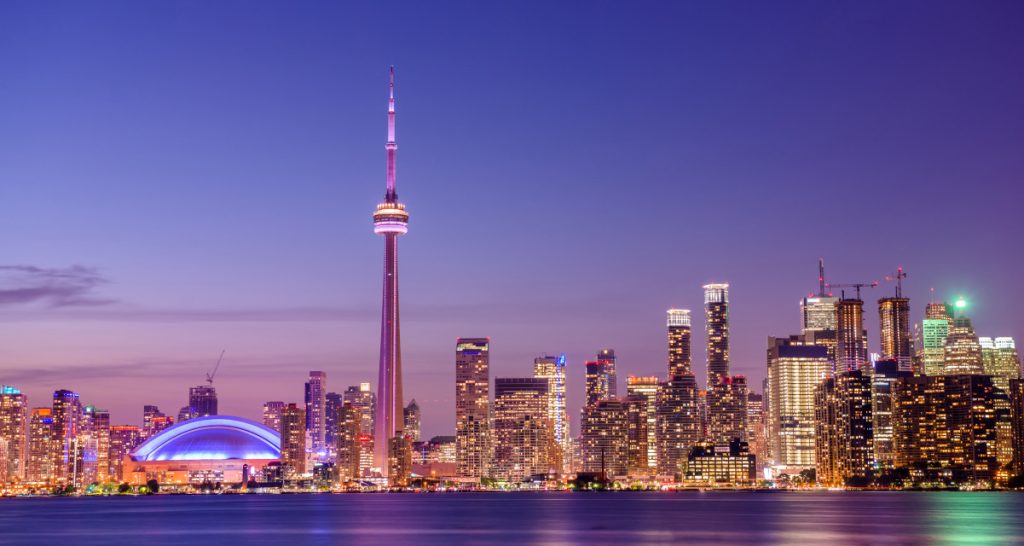

Renowned for their vibrant and often contentious public discussions, the semi-annual Toronto-based Munk Debates bring together some of the world’s most influential thinkers to passionately advocate for their points of view on pressing global issues.
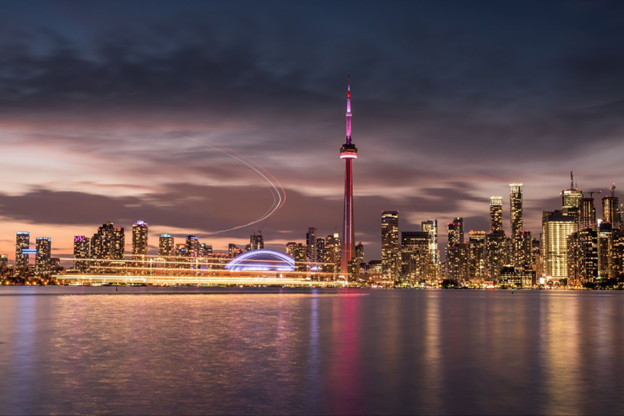
Founded in 2008 by Canadian businessman and philanthropist Peter Munk and his wife Melanie, these debates have captivated audiences with their spirited discussions, compelling arguments, and, yes, a fair share of snarky back-and-forth between the participants.
The format of a Munk Debate includes audience participation. Audiences vote for or against the debate’s motion twice—once before and a second time after the debate. The differences in results can be viewed as indicators of who “won” the debate, or at least which sides held their own if the before-and-after polling percentages did not change significantly.
Audiences are also polled before debates on how many of them are open to changing their pre-debate positions on the motions.
So, without further ado, let’s dive into three of the most unforgettable Munk Debates that have ever graced the stage of Roy Thomson Hall in Toronto, Canada, which has hosted these events since their inception.
The rise of populism
This debate tackled the surge in populist movements across the globe, a highly relevant and polarizing topic. The debate drew significant media coverage.
- Motion: Be it resolved, the future of western politics is populist, not liberal.
- Date: November 2, 2018
- Participants:
- Steven Bannon served as President Donald Trump’s chief strategist in 2017. He also joined the 2016 Trump presidential campaign as CEO in August of that year and is credited with helping guide Trump to victory over Democratic candidate Hilary Clinton. Previous to that, he was CEO of Breitbart News. Bannon is known for his strong advocacy of populist policies.
- David Frum is a well-known author and commentator, a senior editor at The Atlantic, and a former speechwriter for President George W. Bush. Known for his negative views on populist movements, he is a self-described conservative who has criticized what he views are political extremes on both the left and the right.
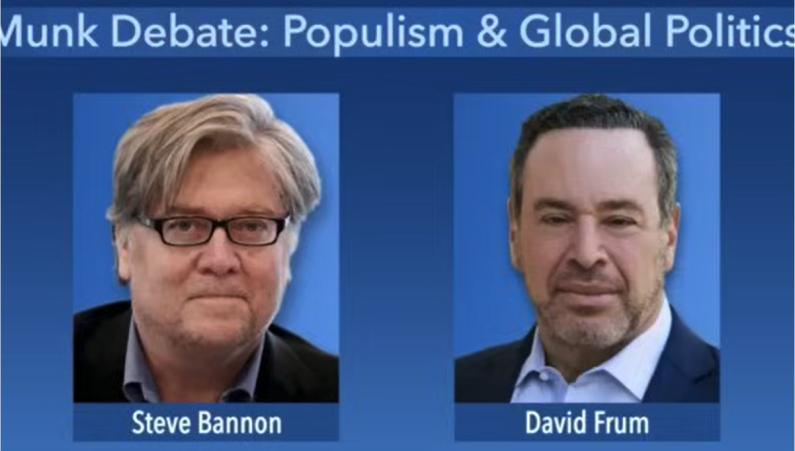
Here’s a summary of the key arguments raised by Bannon and Frum:
Steve Bannon (pro-populism):
- Representation of the “little guy”: Bannon emphasized that the populist movement is driven by ordinary citizens rather than elites. He argued that these “deplorables,” a term first used by Hilary Clinton to describe Donald Trump followers, are the backbone of America and represent the true spirit of the nation.
- Critique of globalization: He argued that the existing global order benefits a small elite at the expense of the majority and that populism seeks to address the grievances of those left behind by globalization.
- National sovereignty: Bannon stressed the importance of national sovereignty and the need for countries to control their borders and destinies.
- Economic policies: He highlighted the need for economic policies that prioritize national interests, such as tariffs and restrictions on immigration. He asserted that such policies in America protect jobs and industries within the nation.
David Frum (anti-populism):
- Threat to democratic institutions: Frum argued that populism undermines democratic institutions by promoting authoritarian tendencies. He claimed that populist leaders often bypass democratic norms and checks and balances.
- Economic shortcomings: Frum said that populist economic policies are often short-sighted and economically damaging. He argued that protectionist measures can lead to trade wars and harm the global economy.
- Global cooperation: He advocated for continued global cooperation and integration, arguing that addressing global challenges such as international security requires collaborative efforts.
- Fact-based governance: Frum emphasized the importance of governance based on facts and expertise rather than populist rhetoric. He argued that complex issues require informed and nuanced approaches that populism often oversimplifies.
Here is a sampling of the back-and-forth dialogue between the two:
Bannon used stories to buttress his arguments, while Frum persistently attacked populism as a divisive force that is doomed to fail.
“We’re at the beginning of a new political revolution, and that is populism,” Bannon argued in his opening statement. “The only question before is, is it going to be a populist nationalism that believes in capitalism and deconstructing the administrative state and giving the little guy a piece of the action and break up this crony capitalism of big corporations and big government, or is it going to be a Jeremy Corbyn and Bernie Sanders type of populist socialism?”
As evidence, he offered a narrative on the US government’s rescue of an over-leveraged banking system, which came to be known as the “too big to fail” financial bailout of 2008.
“On the day that happened (September 18, 2008), the balance sheet of the Federal Reserve was $880 billion. When Donald Trump took the oath of office, January 20, 2017, it was $4.5 trillion. We flooded the zone with liquidity, just like the Bank of Tokyo, the Bank of England, the European Central Bank….
“The elites bailed themselves out, afraid of some sort of deflationary death spiral.
“That’s not a free bailout. There’s a corollary to that. Savings accounts are zero. Pension funds have the biggest gap in history. You can’t underwrite a bond in the United States because you only get, for a public school or waterworks, you get 2%.”
Bannon went on: “The little guy would bear the burden of that. If you’ve owned assets, intellectual property, stocks, real estate, hedge fund, name it, in the last 10 years, you had the greatest run in history. For everybody else, a disaster. 50% of American families can’t put…their hands on $400 of cash….
“It wasn’t Donald Trump. It wasn’t the populist. The populist movement, the nationalist movement, is not a cause of that. It’s a product of that. Donald Trump’s presidency is not a cause of that. [Populism is] a product of that.”
David Frum’s response was to attack President Trump and the populist movement as “the most dangerous challenge that liberal democratic institutions have faced since the end of communism.”
Frum then asked and answered his own rhetorical question: “What is populism? It claims to speak for the people, but it always begins by subdividing the people and by saying some among the people because of their skin or the way they pray or their gender or whom they love or how they conduct themselves or for some other reason, some of the people are not the people, they are those people…
“Why will this populist movement lose and why will our liberal institutions prevail? And at bottom, it’s for one reason, which is, this new populism is a scam. It’s a lie. It’s a fake. It has nothing. Now, I don’t mean that just in the sense that so many of its leaders are crooks, although they are….
“All these scumbags and thieves, they’re in the populist movement.”
So both sides came out swinging, Bannon with his bailout story, which he called the “inciting incident” of the surge in populism, and Frum waving the danger-to-democracy flag and painting populist leaders as “crooks.”
The debate went on to tackle numerous other issues of the day. In the end, voting results on the motion showed the most dramatic shift in audience opinions in the entire history of the Munk Debates.
Poll results for this motion (Be it resolved, the future of western politics is populist, not liberal):
- Before: Yes – 28%, No – 72%
- After: Yes – 57%, No – 43%
It is fair to conclude from the 29% swing in favor of the motion that Bannon’s arguments helped the Munk audience better understand the forces behind current populist movements, and that David Frum’s counterattacks failed to land effective blows.
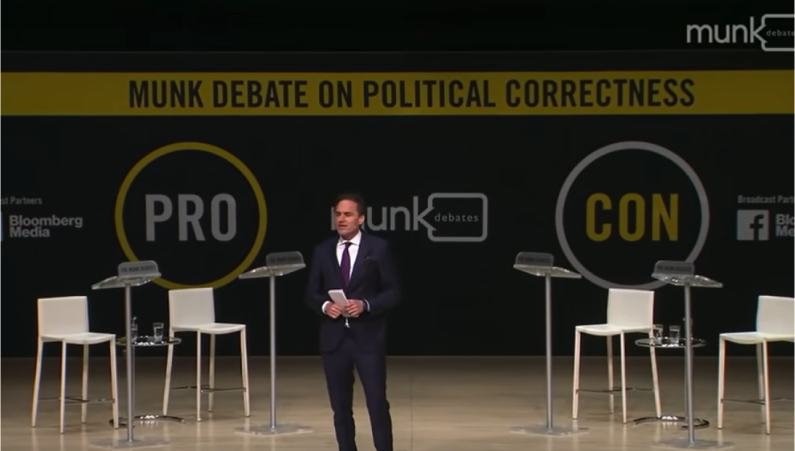
Political correctness
- Motion: Be it resolved, what you call political correctness, I call progress.
- Date: May 18, 2018
- This debate delved into the contentious issue of political correctness, with prominent speakers on both sides. The clash of ideas was intense and thought-provoking.
- Participants: Michelle Goldberg and Michael Eric Dyson argued in favor of the motion. Jordan Peterson and Stephen Fry argued against it.
Dyson and Goldberg argued that political correctness fosters respect and equality, while Peterson and Fry criticized it as a threat to free speech and open discourse.
Some key quotes from the debate:
Michael Eric Dyson:
- “Those who decry political correctness are often those who are resistant to giving up their privilege and power.”
Jordan Peterson:
- “Political correctness is a form of ideological tyranny that seeks to control language and thought. It stifles free speech and open debate, and it is antithetical to the principles of a free society.”
Michelle Goldberg:
- “Political correctness is about respect and decency. It is about acknowledging the impact of our words and actions on others, especially those who have been historically marginalized.”
Stephen Fry:
- “I detest political correctness not because I want to be mean to people, but because it has become a form of censoriousness. It is often more about power and control than about genuine care for others.”
The arguments highlighted the deep divide on the issue and underscored the intense emotions and stakes involved in the discussion. The shift in audience opinion, with a decrease in support for the motion, reflects the persuasive power of the arguments against political correctness.
Poll results for this motion (Be it resolved, what you call political correctness, I call progress):
- Before: Yes – 36%, No – 64%
- After: Yes – 30%, No – 70%
These results show a discernible shift in audience perception toward a less favorable view of political correctness.
Mainstream media
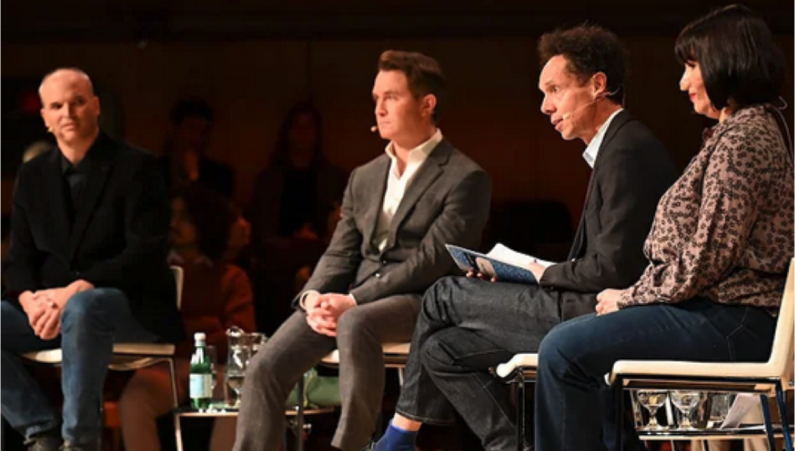
This debate highlighted people’s growing mistrust of the mainstream media, a hot-button issue with major implications for journalism and public trust.
- Motion: Be it resolved, don’t trust mainstream media.
- Date: November 30, 2022
- Participants: Douglas Murray and Matt Taibbi argued for the motion. Malcolm Gladwell and Michelle Goldberg opposed it.
Murray and Taibbi argued that mainstream media has lost its credibility and is often biased or manipulated. Gladwell and Goldberg emphasized its importance in providing reliable information and holding those in positions of power to account.
This debate was particularly impactful due to the high-profile nature of the participants and the relevance of the topic in today’s media landscape, where questions about media trustworthiness and bias are increasingly common.
Some key quotes from the debate:
Douglas Murray:
- “The mainstream media has become a mouthpiece for certain political agendas, often at the expense of truth and impartiality.”
- “We are living in an age where trust in institutions is declining, and the media is no exception. We must hold it to account for its biases and failures.”
Malcolm Gladwell:
- “The mainstream media, despite its flaws, remains a crucial pillar of democracy, providing fact-checked and reliable information that alternative sources often lack.”
- “We should not throw the baby out with the bathwater. While it’s important to criticize and improve the media, we must also recognize its essential role in society.”
Matt Taibbi:
- “There has been a collapse in the standards of journalism, where opinions are masquerading as news, and the line between reporting and commentary is blurred.”
- “The problem with mainstream media is not just the mistakes they make, but the lack of accountability and the failure to correct those mistakes transparently.”
Michelle Goldberg:
- “Journalists in mainstream media organizations work tirelessly to bring us accurate news, often risking their lives to do so. Dismissing their efforts is not only unfair but dangerous.”
- “Trust in the media is foundational to an informed public. Without it, we are left vulnerable to misinformation and propaganda.”
Poll results for this motion (Be it resolved, don’t trust mainstream media):
- Before: Yes – 48%, No – 52%
- After: Yes – 67%, No – 33%
The post-debate results showed a significant shift in favor of the resolution with an additional 19% of the audience agreeing that mainstream media should not be trusted.
Why are the Munk Debates important?
The Munk Debates are pivotal events for addressing the most contentious issues of our time, and set an example of how this can be done in a respectful manner that carefully and transparently considers both sides of an issue.
By bringing together experts and engaging audiences in meaningful discussions, these spirited events contribute to a deeper understanding of complex issues and promote the open exchange of ideas that’s necessary for free societies to prosper.

Leave a Reply