

Is removing plastic waste from our oceans a lost cause? Anyone with a love for our beautiful blue planet would hope not. But the numbers are discouraging.
Every year, the nations of the world dump more than 10 million tons of plastic waste into the oceans. Without intervention, that figure is projected to nearly triple by 2040.
The plastic debris chokes marine wildlife and pollutes valuable ecosystems. It also breaks down into microplastics that have been detected in everything from fish to bottled water to human blood. It is becoming increasingly obvious that these particles have long-term health consequences for our planet, its wildlife, and its people.
Where does ocean pollution come from?
Some of the flotsam and jetsam comes from ships plying the oceans. Fishing boats losing their nets on the rocks. Cargo containers swept overboard in a storm. Careless passengers on yachts and cruise liners dropping plastic dinnerware into the water.
Some of it wafts in from dry land, such as agricultural debris in coastal areas or plastic bags and kites lost to the wind on the world’s beaches.
But surprisingly, the vast majority of the plastic drifting in our oceans is carried in by rivers—the primary highways for ocean-bound debris.
However, not all rivers are created equal when it comes to plastic pollution.
According to a widely cited 2021 study published in Science Advances, roughly 1,000 rivers account for nearly 80% of all plastic entering the oceans. That’s out of an estimated 100,000 river systems worldwide. Even more striking, just 50 rivers are believed to contribute nearly a quarter of that total.
The worst offending rivers and regions
The worst polluting rivers include the Yangtze River in China, the Ganges in India, the Ciliwung in Indonesia, and the Pasig River in the Philippines. All of these flow through cities grappling with massive volumes of uncollected waste.
These rivers run through huge cities with large populations and insufficient or informal waste collection systems. As a result, plastic bags, wrappers, bottles, food containers, fishing gear, and other debris are routinely washed into waterways and ultimately end up in the ocean.
Cleaning up the mess
Fortunately, a number of individuals, organizations, and government agencies have recognized the scale of the problem and the need for action.
Below, we document innovative solutions to ocean cleanup—culminating in the conclusion that the best place to tackle this problem is at its source.
The Ocean Cleanup’s strategy to remove plastic at scale
In 2013, a young Dutch engineering student named Boyen Slat launched an ambitious vision to remove vast amounts of plastic from the world’s oceans.
Slat’s project, The Ocean Cleanup, used massive floating booms to collect waste trapped in circulating gyres (large rotating ocean currents). It gained global attention for its innovative engineering and bold mission to confront one of the planet’s most difficult environmental challenges.
Offshore deployments included removing more than 250,000 pounds of plastic from the Great Pacific Garbage Patch during a single cleanup campaign. However, Slat and his team found that working in the open ocean brought steep costs, frequent maintenance challenges, and unpredictable results.
They concluded that trying to clean up the ocean without choking off the flow of plastic waste at its source was like endlessly bailing water from a leaky boat.
The Ocean Cleanup’s focus on rivers
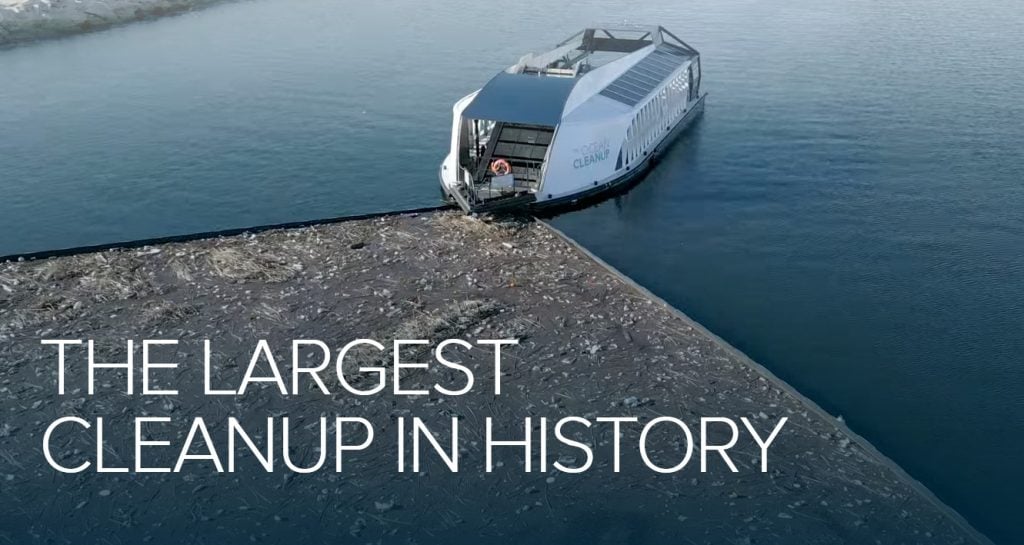
In response to that stark lesson, The Ocean Cleanup recalibrated its approach. Slat and his team introduced the Interceptor—a solar-powered, autonomous vessel designed to extract plastic directly from rivers, where most marine plastic originates.
The machine uses a conveyor belt to collect waste and offload it into dumpsters for removal before it reaches the ocean. Interceptors have now been deployed in Malaysia, Indonesia, Vietnam, Jamaica, and the Dominican Republic, according to The Ocean Cleanup’s Impact Dashboard. Additional rollouts are being planned as well.
Each Interceptor is capable of removing up to 50,000 kilograms of plastic per day. Improved models can handle twice that amount under optimal weather conditions. With simpler logistics and lower costs per kilogram, the Interceptor has become the centerpiece of The Ocean Cleanup’s scalable solution to keeping the oceans from being overrun by plastic waste.
The role of beach cleanups in battling ocean pollution
Beach cleanups are another viable approach to reducing ocean pollution. They represent one of the most visible and community-driven responses to ocean plastic.
One of the largest of these efforts is Ocean Conservancy’s Trash‑Free Seas initiative, which has mobilized more than 17 million volunteers in 153 countries to collect over 350 million pounds of trash. In 2022 alone, their teams removed an estimated 9 million items from beaches—mostly plastic wrappers, bottles, cigarette butts, and fishing gear.
These efforts do more than clean beaches. They raise public awareness about the size of the problem and generate valuable data on pollution patterns. They also help advocate for policies like bans on single‑use plastics and something that’s called “extended producer responsibility” (EPR).
EPR is an accountability model in which manufacturers are held to task (often financially) for collecting, recycling, or safely disposing of their products and packaging once consumers discard them.
For example, Ireland’s EPR system for packaging has seen recycling rates soar in that nation. Similar systems exist across Europe and in countries including Japan, South Korea, Canada, and in several US states.
However, beach cleanups have their limits. They obviously don’t address the massive volume of plastic entering oceans from upstream rivers. They also rely on volunteer labor, which is challenging to scale. Yet, beach cleanups are a vital part of defending our oceans.
A low-tech river cleanup solution in Baltimore
In Baltimore’s Inner Harbor, a floating contraption with cartoonish eyes and a solar-powered conveyor belt has quietly become one of the most effective river cleanup tools in the United States.
Mr. Trash Wheel, created by Clearwater Mills and operated by the Waterfront Partnership of Baltimore, has removed more than 1,800 tons of trash and debris since its launch in 2014.
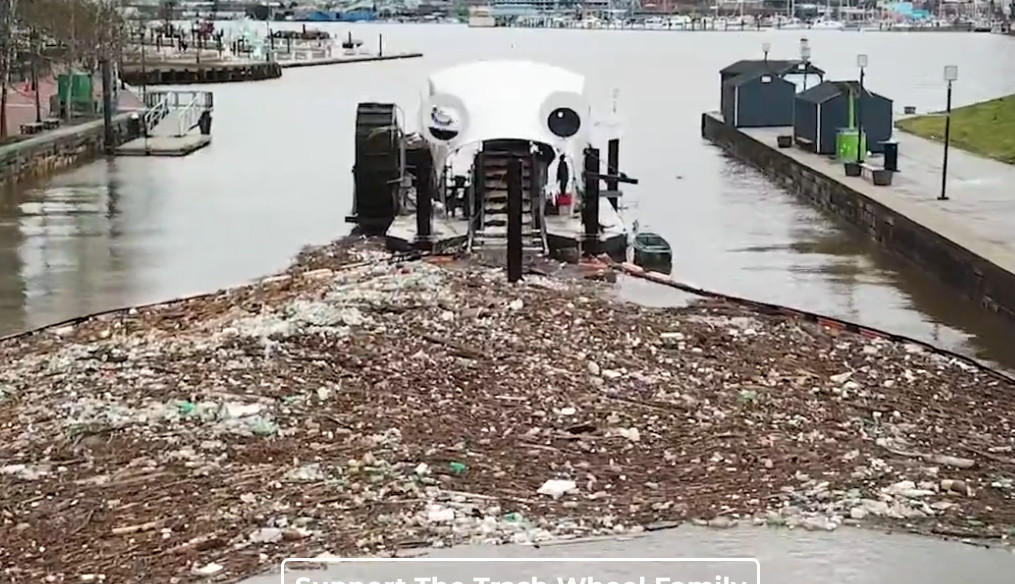
The device works by harnessing the river’s current to guide floating trash—everything from plastic bottles to Styrofoam containers—onto a conveyor belt, which lifts the waste into onboard dumpsters. When the current slows, solar panels power the mechanism, so the device is fully self-sustaining.
Mr. Trash Wheel is a bit of a local sensation. Its googly-eyed branding and quirky social media presence have helped raise awareness about river pollution and ocean-bound plastic. In the Baltimore area, there are now four trash wheels, each with quirky names, operated by the Waterfront Partnership.
Why Mr. Trash Wheel’s low-cost model is gaining global attention
Despite its humor, Mr. Trash Wheel’s results are serious. Like a floating Pac-Man, the machine gobbles up and removes thousands of pounds of watery waste per month at a fraction of the cost of high-tech alternatives.
The design is low-maintenance, easy to replicate, and highly adaptable to other mid-sized, trash-laden rivers. This fact is not lost on other cities exploring scalable, community-backed solutions.
Because it’s relatively inexpensive and doesn’t require complex installation, Mr. Trash Wheel offers a compelling model for municipal-level river plastic interception. Especially in urban areas where public engagement and visibility are important, it can provide an alternative to industrial-scale solutions like The Ocean Cleanup’s Interceptor.
While it won’t solve ocean pollution all by itself, Mr. Trash Wheel proves that ingenuity, community buy-in, and a bit of whimsy can go a long way in turning the tide, one river at a time.
What countries are doing to stop river plastic pollution
While large-scale initiatives like The Ocean Cleanup and Mr. Trash Wheel make headlines, smaller, locally-led river cleanup projects are quietly delivering impressive results around the world. These efforts are often more nimble, affordable, and embedded in the communities they serve. This gives them unique advantages in hard-to-reach areas with limited infrastructure.
In India, for example, the National Mission for Clean Ganga has deployed floating trash barriers in multiple states to capture waste from rivers before it reaches the Bay of Bengal, according to Clean Ganga’s official reports.
In Vietnam, TONTOTON partners with local authorities and waste workers to intercept ocean-bound plastic in urban canals and informal settlements.
Meanwhile, in Ghana and Nigeria, youth-led social enterprises are collecting plastic from polluted waterways and converting it into eco-bricks, reusable products, and construction materials.
Community cleanup efforts where big tech can’t reach
These grassroots initiatives often rely on manual labor, floating booms, and simple trash traps. While they may not match the volume of industrial-scale projects, they excel in cost-efficiency and getting the local populations involved in the cleanup effort. Many of these initiatives are paired with job creation programs, recycling incentives, and educational outreach.
Because they’re locally rooted, these efforts can often move faster than centralized solutions and face fewer regulatory obstacles. In that way, community-based river cleanup projects offer a scalable, adaptable model, especially in countries where infrastructure gaps make high-tech interventions less feasible.
Together, these global projects show that preventing ocean pollution doesn’t always require billion-dollar budgets. Sometimes, well-executed smaller ideas go a long way.
Why stopping pollution upstream matters most
For all the global momentum that’s building around ocean cleanups, the clearest and most cost-effective path forward lies upstream—in the rivers that carry the vast majority of plastic into the sea.
Interception systems like The Ocean Cleanup’s Interceptor and city-based solutions like Mr. Trash Wheel offer the best return on investment. They’re relatively low-cost, easier to maintain than offshore systems, and capable of removing large volumes of plastic waste before it ever reaches open water, where recovery becomes exponentially harder and more expensive.
But even the smartest technology can only do so much. The elephant in the room is this: most plastic pollution originates in countries that are still developing the infrastructure needed to manage it.
In many parts of Southeast Asia, Sub-Saharan Africa, and Central and South America, rapid urbanization has outpaced the necessary investment in basic waste collection, recycling, and landfill management.
These fast-growing regions are now responsible for a disproportionate share of plastic waste floating in the world’s oceans. And while their governments may be willing to act, many lack the policy tools, funding mechanisms, or regulatory capacity to enforce meaningful change.
What’s really needed to solve the problem
What kind of “intervention” could change this course? According to one 2020 report, Breaking the Plastic Wave, solving the problem once and for all would require a system-wide transformation across the entire plastic lifecycle. It would need to include:
- Drastically reducing plastic production and consumption (especially of single-use plastics) by redesigning products and packaging.
- Rapidly scaling up successful models for reusing or refilling plastic containers such as disposable water bottles.
- Expanding waste collection services in regions with the highest rates of unmanaged plastic waste, particularly in parts of Southeast Asia, Sub-Saharan Africa, and Latin America, where infrastructure gaps contribute hugely to ocean-bound pollution.
- Overhauling recycling systems to process a much greater share of plastic waste.
- Implementing government policies that make virgin plastic less economically attractive than recycled alternatives.
The report, sponsored by Pew Charitable Trusts and SYSTEMIQ, estimates that a mix of key solutions, from reduction and substitution to better waste management, could cut ocean plastic flows by more than 80% by 2040.
Global action where it matters most
Voluntary beach cleanups, ocean skimmers, and river collectors alone won’t turn the tide. Without upstream action, the cycle of waste will continue: intercepting some plastic while even more flows into the sea right behind it.
The solution to ocean plastic is upstream, both literally and figuratively. It lies in supporting the places that need help the most and where investment, infrastructure, and policy can make the greatest difference.
We have the tools. We have proof of concept. Now, the world’s attention and resources need to focus on stopping plastic pollution at its source.

Leave a Reply