
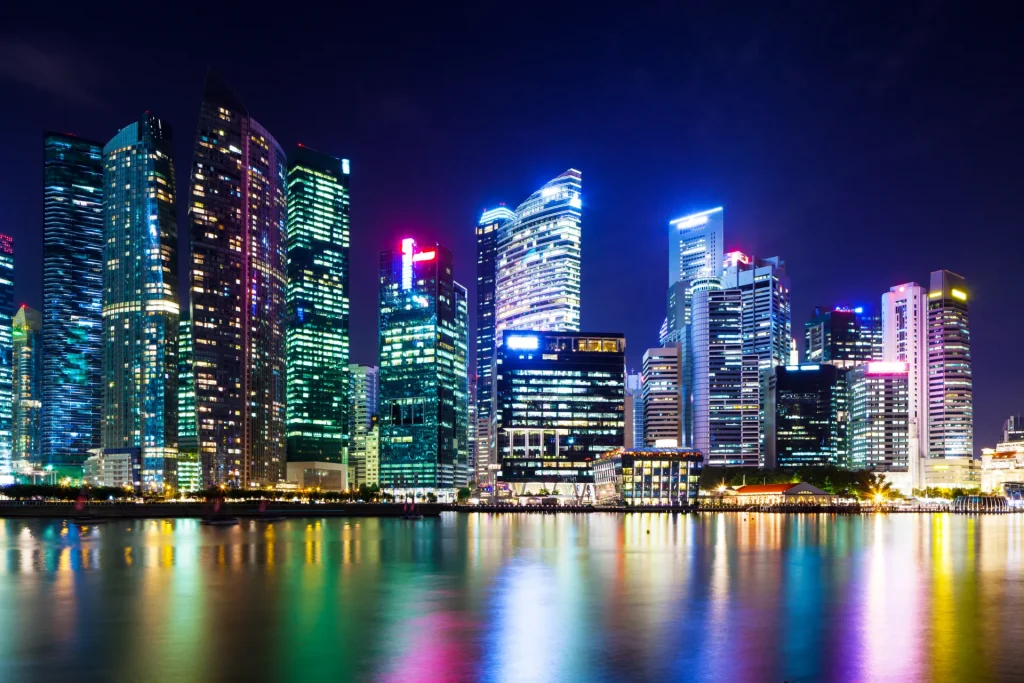

Singapore’s pro-business reputation is renowned throughout the world and has even earned the island nation the moniker Singapore Inc.

But Singapore Inc. is more than a metaphor. It’s a testament to how sound business strategies, aligned with a robust legal framework that regulates but does not stifle business opportunity, can drive a nation’s economic success.
A key component in Singapore’s recipe for success is business integrity. When the city-state won its full independence in 1965, it turned its back on its freewheeling past as a thriving but corrupt, crime-infested British colony.
Today, it is known for its strict anti-corruption laws. Also, as noted in a recent managementstudyguide.com report, Singapore ingeniously incentivizes its government bureaucracy by tying bureaucrats’ salaries to the performance of the nation’s economy. “For instance, during the 2008 crisis when the economy went down, Singapore’s bureaucrats lost money,” the website reported.
As Singapore continues to innovate and adapt, it serves as a model for other countries aspiring to carve out significant niches in the global marketplace.
Why is Singapore so attractive to business?
Let’s have some fun with this question. We’re going to imagine that Singapore Inc. is a business instead of a sovereign nation, in an effort to discern what its business model would be if it were a business.
Let’s start with defining perhaps the most important element of a business model, which is its value proposition.
In the context of business models, a value proposition is a clear, concise statement that explains how a product or service solves a problem, meets a need, or delivers benefits to customers. It highlights what makes these products or services unique and why they are better than alternatives.
Singapore’s value proposition
The nation’s value proposition might sound something like this:
“Offering a strategic geographic location, robust legal framework, competitive tax environment, world-class infrastructure, and a highly skilled workforce, Singapore provides a secure, efficient, and innovation-driven hub for global businesses to thrive and expand in Asia and beyond.”
If Singapore were a company, its business model would likely be a hybrid of a diversified corporation and a service provider that emphasizes innovation, strategic positioning, and high-value service delivery. Singapore’s attraction to business lies in the powerful elements listed in the above value proposition that few nations can match in full.
Singapore’s core business sectors
Singapore’s business model is characterized by the following core components:
- Finance and trading hub: As a global financial center, Singapore would be like a company specializing in financial services that attracts international banks, investment firms, and finance-tech startups. Its strategic location and stable economy make it a pivotal gateway for capital flows in Asia.
- Logistics and transportation: With one of the busiest ports in the world, Singapore functions like a well-oiled logistics company. It facilitates global trade through advanced maritime and air cargo services. Efficient and corruption-free customs, cutting-edge port technology, and strategic trade agreements further streamline doing business in the country.
- Investment in research and technology: Similar to a tech company, Singapore invests heavily in research and development. It aims to be a global leader in smart technology, biotech, and sustainable urban solutions . It promotes innovation through incentives for startups and serves as an important hub for regional tech offices.
- High-end tourist appeal: Singapore operates much like a top-tier service provider of high-end accommodations, attractions, and shopping experiences for both visitors and residents. This sector of Singapore’s economy is meticulously managed to maintain and grow the country’s appeal as a global tourist destination.
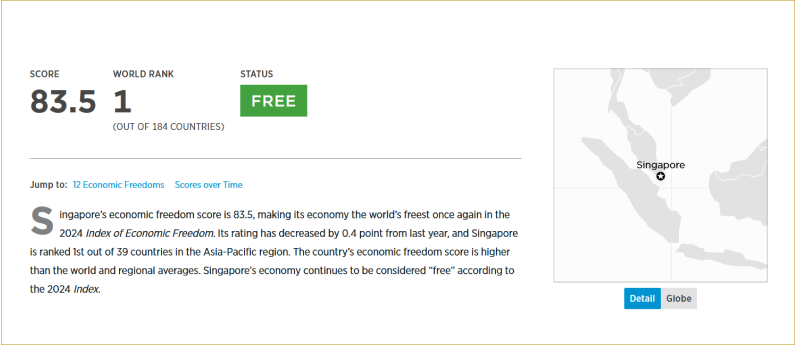
It’s no small accomplishment that as of 2024, Singapore continues to hold the top position as the world’s most economically free country, according to the Heritage Foundation’s Index of Economic Freedom.
Revenue streams if Singapore were a business
Singapore Inc. has developed a number of highly sustainable revenue streams, ranging from taxation to government investments:
Corporate tax revenues
Singapore collects revenue through corporate taxes, goods and services tax (GST), and other levies, such as a vehicle quota system.
The nation collects significant revenue from its steep taxes on vehicles. All other taxes are relatively low, but they are efficient due to the high volume of business conducted in the country.
For example, a multinational company with its regional headquarters in Singapore benefits from the competitive flat corporate tax rate of 17%, as well as the country’s streamlined regulatory framework. The substantial profits generated from regional operations lead to significant corporate tax payments to the Singaporean government.
Another example involves the country’s 8% GST. Retail businesses in Singapore, from luxury boutiques to everyday supermarkets, charge GST on their sales. The cumulative effect of GST, collected from a high volume of consumer transactions, provides another steady stream of revenue for the government.
Income from direct investments
Singapore also harvests income from direct investments in state-owned enterprises such as telecommunications, transportation, and real estate. These enterprises not only serve national interests but also generate substantial revenue.
The two most important of these are Singtel (Singapore Telecommunications Limited) and SMRT Corporation.
Singtel: Singapore’s public-private telecom company
Singtel provides mobile, broadband, and fixed-line phone services and operates in multiple countries. The company owns significant stakes in telecom companies in Australia (Optus), India (Bharti Airtel), and several other countries.
Though Singtel is majority-owned by a state-owned investment company, Temasek Holdings, its stock is publicly traded. This makes for an effective public-private partnership, which is an interesting element of Singapore’s “business model.”
Singtel reported 14 billion in revenue in 2022.
SMRT, the Singapore government’s public transportation company
SMRT, on the other hand, is wholly owned by the government through Temasek.

SMRT operates Singapore’s mass rapid transit system, light rail transit, and bus services. It is the backbone of Singapore’s efficient and reliable transit services across the city-state. SMRT generates revenue through fares, advertising, and commercial space rental within its stations.
SMRT’s 2022 revenue was approximately SGD 1.3 billion.
These two state-owned enterprises play a key role in Singapore’s economy. They make it possible for strategic sectors to remain under national control while also contributing significantly to the country’s income.
Income through foreign investment
The nation also generates income from fees and taxes by attracting foreign investment through favorable business conditions, strategic economic agreements, and a reputation for integrity and efficiency.
For example, Citibank, a major global financial institution, uses Singapore as a key hub for its operations in the Asia-Pacific region. Citibank’s operations in Singapore include a regional headquarters, wealth management services, and a trading floor. This foreign-based bank’s presence in Singapore generates substantial tax revenue and high-value jobs for the country.
A business model that generates solid, steady revenue
Through the combination of low but efficient corporate taxes and GST, coupled with high vehicle-related levies, Singapore effectively collects substantial revenue.
This revenue is reinvested in public services and infrastructure and is used to maintain the country’s business-friendly environment. This perpetuates a cycle of economic growth and stability.
Competitive strategy
Singapore’s business acumen is supported by a smart competitive strategy.
Like a company protecting its brand, Singapore meticulously manages its international image as a clean, safe, and business-friendly country.
A core element of its business model is the innovation and adaptability it is known for, which is a remarkable quality for a nation-state to possess. Singapore is continuously evolving its services and infrastructure to stay competitive, similar to how a company innovates to meet changing market demands and technological advancements.
Plus, the country attracts skilled labor and intellectual capital from around the world through favorable immigration policies that mirror a company’s efforts to hire and retain top talent. In return, multinational corporations setting up shop in Singapore can leverage the nation’s strategic location, skilled-labor market, and business-friendly environment to access Asian markets.

Which Singapore industries fuel its economy today?
Singapore’s economy is fueled by several key industries that continue to contribute significantly to its growth and development. The diversity of its economy is another key element of its business model. Singapore’s core industries include:
- Financial services
- Electronics manufacturing
- Logistics and supply chain management
- Biotechnology and pharmaceuticals
- Information and communications technology
- Tourism and hospitality
- Oil and gas refining, storage, and trading
- Biomedical sciences
- Real estate and construction
- Education and training
The remarkable history of the remaking of Singapore
No business model analysis can truly capture the Herculean transformation of Singapore from a crime-infested British colony devastated by World War II to the thriving bastion of business excellence it is today. That would require another in-depth story beyond the scope of this article.
However, here are the key postwar events that contributed to Singapore’s long march of progress:
- The Japanese surrender in 1945 marked the beginning of the British re-occupation of Singapore. The war had left the country in shambles, and rebuilding efforts were essential for recovery.
- The British initiated reforms to improve living conditions, rebuild infrastructure, and restore law and order, including improvements in public health, education, and housing.
- The People’s Action Party (PAP), led by Lee Kuan Yew, was founded in 1954 to address the socio-economic issues facing Singapore. The party’s rise to power marked a turning point in Singapore’s political landscape.
- In 1959, Singapore gained self-government with Lee Kuan Yew as its first Prime Minister. This allowed for greater autonomy in internal affairs and set the stage for significant reforms.
- Hoping for economic progress, Singapore merged with Malaysia in 1963. But political and ethnic tensions led to Singapore’s separation from Malaysia shortly thereafter.
On August 9, 1965, Singapore became an independent nation. This event marked the beginning of an era of rapid development and modernization under the leadership of Lee Kuan Yew.

Transformation highlights
Under Lee Kuan Yew’s leadership, Singapore began its epic turnaround with these key steps:
- The PAP-led government implemented strict anti-corruption laws and established the Corrupt Practices Investigation Bureau to ensure a clean and efficient administration.
- The new government initiated policies focused on diversifying the economy from a heavy reliance on trade to manufacturing and industrialization. These efforts targeted new foreign investments as well. Developing Singapore’s financial sector was also a key part of the diversification.
- Significant investments were made in education to develop a skilled workforce capable of supporting a modern economy.
- The government also prioritized the development of infrastructure, including transportation, public housing, and utilities. The goal was to build infrastructure and a social environment conducive to business and to raise its residents’ standard of living.
- Beyond the business-related moves by Singapore’s leaders, major social initiatives were implemented as well. Foremost among them were programs to socially unify and educate its diverse population of Malays, Indians, Chinese, Europeans, and other ethnic groups. For example, in 1965, Singapore adopted English as the primary working language.
English was chosen because it was neutral among the various ethnic groups and was seen as a global language that could facilitate international trade and communication.
English became a compulsory subject in schools from primary education onward. All subjects (except for mother tongue languages) are taught in English. The government promotes the use of English in the media, including television, radio, and print. Most newspapers and news broadcasts are in English. It’s also the primary government language.
Though English is the main medium of instruction, students also learn their mother tongue (Mandarin for Chinese students, Malay for Malay students, Tamil for Indian students) to preserve their cultural heritage. By adopting English as the primary working language, Singapore successfully created a cohesive society while positioning itself as a competitive, globally connected nation. - In addition to its language initiatives, Singapore’s housing policy has been instrumental in promoting racial harmony and nurturing a unified national identity. Singapore’s Ethnic Integration Policy (EIP) ensures that no single ethnic group can dominate a neighborhood. Administered by the government’s Housing and Development Board (HDB), the EIP sets quotas for the different ethnic groups in what are known as HDB estates.
Singapore’s long journey to economic prosperity
The elements of Singapore’s profoundly successful business model—strategic geographic location, robust legal framework, competitive tax environment, world-class infrastructure, and a highly skilled workforce—are seemingly self-evident. However, raising the nation up from where it was 70 years ago in the aftermath of World War II, was and is an astonishing feat by astonishingly dedicated and honorable national leaders such as Lee Kuan Yew.
It also could not have been done without the work ethic of its resilient people, gleaned from diverse ethnicities, working together harmoniously for the greater good. If the past is prologue, Singapore can look forward to a strong continuation of its transformative journey to prosperity and success.

Leave a Reply