

Circular saws hum, nail guns crack, tape measures snap back into place. Inside the shop at Great Falls High School, Montana, students move with focus. They lay out the top and bottom plates and the studs of an exterior wall. Nearby, another group is gunning floor joists to rim boards. This is not a mock-up or a practice wall that will be torn down at semester’s end.
These kids are framing an actual house.

The work meets local building codes. Inspections by city officials are real. When the last nail is driven, a family will live in the home. What looks at first like a school project reveals itself as something more: responsibility, handed squarely to these students.
So, what’s the best age to launch into a construction apprenticeship? This story makes the case for starting early!
Great Falls High’s unusual take on construction apprenticeships
Most people picture construction apprenticeships as starting after high school. A young person joins a trade, works under experienced builders, and learns on the job while earning a paycheck. That assumption is largely correct. In most communities, exposure to skilled trades comes after high school.
High school programs, when they exist, are often introductory. Students are first given a heavy dose of safety instructions. Then they learn tool basics, build small projects, and move on.
Great Falls takes a different approach. Instead of waiting for students to graduate before introducing real-world standards, the program moves those standards into the school day itself. Teenagers don’t just learn about construction apprenticeships. They get involved in them while still in class.
That shift nurtures competence. From there, the story becomes about outcomes, not grades, and that starts with the houses themselves.
Building real houses for real families
The work that begins in the shop does not end at the school doors. Through a long-running initiative known locally as the High School Homes program, students build real houses that are completed, inspected, and sold to families in need through a community partnership.
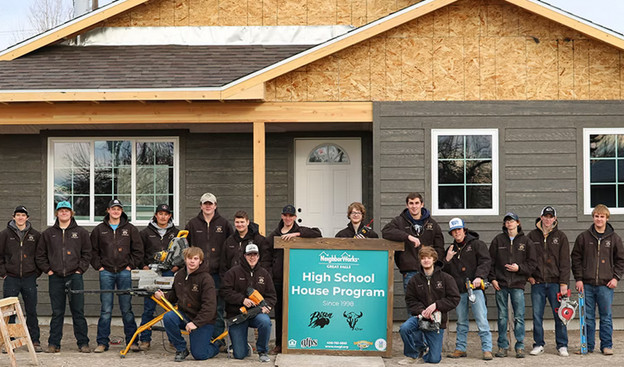
Some of the work happens inside the school. In the shop, students assemble wall panels, lay out framing members, and build sections of floor systems where precision and repetition matter most.
Other phases shift to the job site itself. As the house gets framed, students work outdoors, adjusting to weather, schedules, and inspections that cannot be paused when a school bell signals the next class. Where the work happens depends on the construction phase.
The community partner that makes this possible is NeighborWorks Great Falls, a local housing nonprofit that provides building lots, helps coordinate subcontractors, and assists with materials and construction financing.
NeighborWorks also works directly with future homeowners. The organization offers education, planning support, and down-payment assistance so the finished houses become affordable, code-compliant homes for local families.
A community partnership that turns learning into housing
This partnership has been in place since 1998. Since then, students have helped build 47 homes across Great Falls and are now at work on their 48th High School House. In the course of those projects, supervised students have participated in nearly every phase of construction—framing, roofing, siding, and finish work.
That decades-long track record matters. This is not a one-off pilot program. It is a working system that has outlasted shifts in education trends and workforce policy.
The difference between this and typical project-based learning becomes obvious on site. There is no margin for “good enough.” Walls must be square. Schedules matter. Materials cost money. When students leave for the day, the structure remains exposed to weather, inspections, and timelines.
Responsibility is the teacher here. And that kind of responsibility does more than produce a finished house. It also prepares students for the realities of construction work, long before they encounter the real world of construction.
Why early exposure matters in the skilled trades
By the time many students encounter regular types of construction apprenticeships, the learning curve is steep. Job-site norms, safety expectations, skills to learn, and accountability all arrive all at once. For some, that combination is enough to intimidate them before they begin.
Early exposure to the trade lowers that barrier.
Students who spend months building real homes learn more than how to use tools. They learn how a job site runs. They understand why tasks happen in a certain order. They internalize safety habits. Showing up on time, cleaning up properly, and owning mistakes become normal.
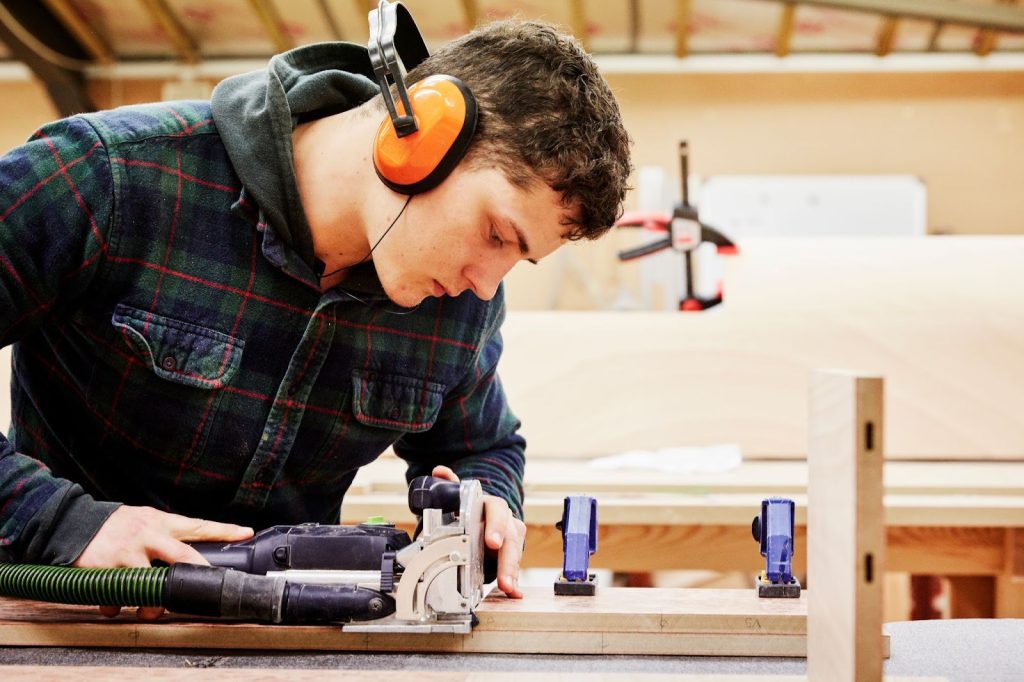
These gains don’t appear on high school transcripts. There’s no line item for confidence earned by solving real problems under pressure. But employers notice it immediately.
For students in this program who later enter the construction trade, the transition is smoother because the environment feels familiar. Expectations make sense.
For families and students asking how to prepare for success in a construction trade, the answer is simple and often overlooked: you start earlier than most people do.
The team behind the tool belts
Programs like this are often described in terms of facilities, funding, or curriculum. But inside the shop, the most important constant is the instructor.
The shop teacher sets the tone before any work is started. Standards are clearly spelled out. Safety is non-negotiable. Students know what counts as acceptable work because expectations are the same every day.
“It just takes a few stubborn people in various organizations who won’t take no for an answer,” skilled trades proponent Mike Roe noted in a recent profile of the program.
In Great Falls’ case, those partners are “too many to name,” Roe added. “But a quick shout out to Pete Pace, the shop teacher at the center of High School Homes, the administrators in the school district, the principal at Great Falls High, Sherrie Arey and her devoted crew at NeighborWorks, the incredibly generous executives at Wells Fargo who offered another round of financial support, and a Governor with the good sense to push through the normal bureaucratic nonsense that kills programs like this.”
The continuity of those key supporters builds trust. Students take correction from a respected teacher seriously because it is consistent. They take responsibility seriously because it is modeled. Over time, the shop becomes less about supervision and more about shared standards.
This is an ingredient that can’t be cloned. Equipment can be purchased. Lesson plans can be copied. But programs like this tend to succeed when leadership is steady, experienced, and respected. Where that leadership is absent or frequently changing, the work rarely holds together long enough to produce successful outcomes.
It helps explain why these programs are uncommon. They depend on commitment, and commitment is harder to replicate than tools.
Public-private partnerships without the red tape
The High School Homes program works because each partner does one job and then steps back.
The school district provides the instructional framework and schedule. The housing nonprofit supplies lots, coordination, and buyer support. Local subcontractors step in where licensed expertise is required. Private funding and donations help cover materials and gaps that schools cannot legally absorb. A local bank helps with the financing.
What is missing is just as interesting. There’s no central office directing daily decisions. No layered approval process is slowing the work. The program stays practical by design.
Support is present but not intrusive. Oversight exists without micromanagement. Each contributor understands the goal and trusts the others to do their part.
This hands-off structure keeps the focus where it belongs: on building houses well and teaching students how real construction work actually unfolds.

What happens to students after graduation
The most common question is, does this high-school-level apprenticeship work lead anywhere?
For many students, it does. Graduates move into local construction apprenticeships, entry-level trade jobs, or further technical training. Moreover, they take those steps while having meaningful advantages. They understand job-site expectations. They arrive with confidence.
Others take different paths. Some pursue college while working in the trades. Some step directly into paid work. Some explore related fields such as electrical, plumbing, or construction management.
What students gain is not a predetermined outcome, but a grounded starting point. They leave school knowing how to build something real, and that their work has value.
What we lost when shop class disappeared
For much of the 20th century, vocational education and shop classes were familiar parts of the American high school experience. Students could take woodworking, metalwork, automotive repair, drafting, and other job-ready courses alongside English and math. Over decades, however, many schools scaled those offerings back or eliminated them altogether as academic standards and college preparation became the dominant metric of success.
Between 1990 and 2009, the number of career-technical credits earned by US high school students declined by about 14 percent, according to the Brookings Institute. Schools faced pressure to boost standardized test scores and graduation rates. Practical, hands-on classes were often the first to be cut.
The result has been a loss of exposure to real work. Many graduates leave school with strong academic knowledge but limited experience with hands-on work. That gap contributes to workforce shortages in skilled trades, as well as a feeling among young people entering the workforce that they lack tangible, meaningful skills.
What apprenticeship programs like this help restore
Programs like the High School Homes initiative address that problem. They restore respect for skilled work by giving students real responsibility and helping them make a visible contribution in their own communities.
When teens see a framed wall weathering its first storm or the keys to a finished home handed to a family in need, learning connects to purpose in a way that sitting through another lecture can’t.
These programs link academic learning to real-world contributions. Math and measurement matter because they are needed to properly lay out floor joists and frame square walls. Planning and sequencing matter because schedules keep a job on track. Students see the value of their work not in abstract grades, but in homes that shelter families and strengthen neighborhoods.
An enduring construction apprenticeship model
What makes this model enduring is that students are trusted with real work, and that trust changes how learning feels and what it produces. The result is not just houses or job readiness, but a sense of contribution that carries forward into real life.
At Great Falls High, this future workforce is not waiting to be trained later. Their professional lives are already taking shape in classrooms and on job sites where expectations are clear, and responsibility is real.
2 responses to “Construction Apprenticeships Reinvented: Inside a High School Where Students Are Building Real Homes”
-
Bravo! This is an excellent article about something very positive happening in the real world. I am encouraged and heartened to read about the High School Homes Project. Thank you for this article!!!
-
Down-to-earth story. Yea!


Leave a Reply