
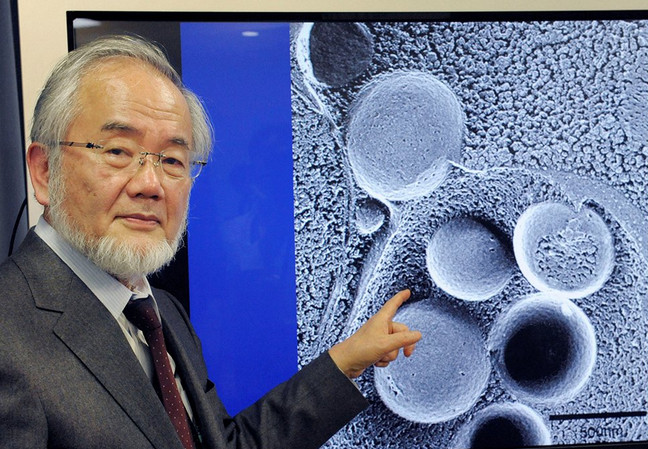

Our understanding of autophagy began with a lone scientist staring into a microscope, watching a silent miracle unfold inside a starving yeast cell. Yoshinori Ohsumi had no funding for a grand project, no cutting-edge laboratory tools, and no reason to believe anything remarkable would happen.
Yet as he peered through the eyepiece in his small Tokyo lab, he saw tiny vesicles—little membrane bubbles that cells use to carry things—drifting inside the cell’s vacuole, its roomy storage chamber. In that still moment, inside a creature no bigger than a dust mote, Ohsumi glimpsed a hidden recycling system at work.
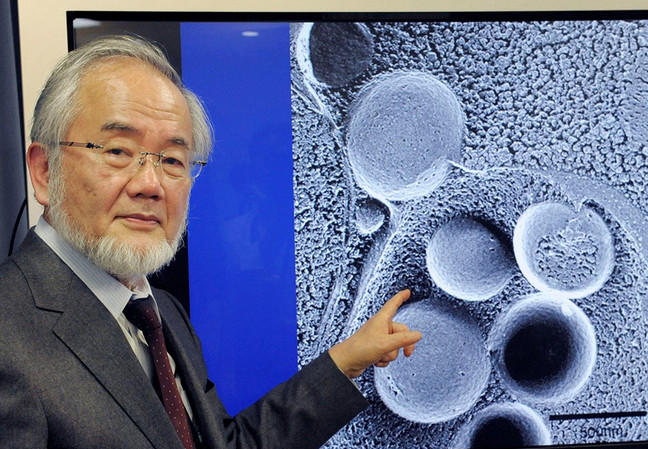
It was the beginning of a discovery that would eventually earn him a Nobel Prize. And it opened a new window into one of life’s most fundamental mysteries: how living cells preserve themselves, repair themselves, and quietly keep us alive.
A hidden repair system comes into view
Ohsumi called this hidden activity autophagy, a term that literally means “self-eating.” It sounds dramatic, but the process is anything but destructive. It is how cells clear away broken parts and recycle what they can. Without it, physical bodies would slowly fill with their own debris.
What made Ohsumi’s work so important is that he didn’t just confirm that autophagy existed. He showed exactly how it happens.
He identified the genes that control autophagy, the steps that set the process in motion, and the conditions that cause it to ramp up. In doing so, he revealed an extraordinary internal repair cycle that has been operating inside every living organism for billions of years.
Scientists later discovered—through work by researchers around the world studying nutrient sensing and cellular stress—that this cleanup cycle becomes far more active when the body senses a drop in incoming energy. That is exactly what happens during a fast: with no new calories coming in, the body begins relying on its own reserves.
How the body shifts into repair mode
When this happens, the signals that normally tell cells to grow and build start to quiet down. In building mode, cells focus on taking in nutrients, making new proteins, storing energy, and handling the constant demands of daily life.
At the same time, the signals that encourage repair, recycling, and efficiency come to the foreground. This shift is one of the main reasons fasting has become a powerful area of study. When you go without food for a stretch of time, insulin falls, nutrients grow scarce, and cells adopt a more resourceful mode.
It’s a bit like walking into your kitchen and finding the cupboards nearly bare. Instead of heading to the store, you start digging through the pantry, gathering forgotten ingredients from the back shelves and turning them into something useful.
Fasting pushes cells to do much the same. They begin to search inward, gather worn-out parts, and turn them into fuel.
How fasting activates deeper repair
Autophagy sits at the center of that shift. As the body runs short on incoming energy, cells begin recycling older proteins and other spent materials and turning them into usable energy.
These “spent materials” include older proteins the cell has already used, small bits of damaged membranes, and worn or faulty structures that are no longer working well. Every cell carries some of this internal clutter as a natural part of daily life. Autophagy prompts the cell to break these pieces down and turn them into useful building blocks or fuel.
This doesn’t happen instantly or in the same way for every person, but the broad pattern is clear: fasting helps push the body toward deeper cellular repair.
Researchers studying intermittent fasting—eating within a daily window such as three to eight hours—are now trying to map this shift with more precision. They study when autophagy begins, which signals trigger it, and how diet, muscle mass, and a person’s overall health and energy use influence the timeline.

Autophagy steps up during fasting because the body finally gets a break from incoming food. When we graze or snack throughout the day, the body stays in “fed mode,” with insulin and nutrients telling cells to focus on building and energy storage. Cleanup stays quiet at that time.
But when we leave longer gaps between meals, those signals fall and trigger essential repair processes that are necessary for health and longevity, and even for cancer prevention.
The story behind this discovery
It took a long time to understand this remarkable process. For most of human history, no one knew what cells actually do when food grows scarce.
That changed in the late 1980s, when Japanese biologist Yoshinori Ohsumi began studying yeast cells under starvation conditions and observed something no one had clearly documented before: cells breaking down their older or damaged parts and recycling them for survival.
His experiments revealed a set of genes responsible for this process—now called the ATG genes. This opened the door to understanding the cleanup cycle now known as autophagy.
In the years that followed, researchers around the world began piecing together how cells decide when to shift from building mode to repair mode. They discovered that when nutrients are plentiful, a major regulator called mTOR stays active.This protein complex tells cells to build, store, and multiply. But when nutrients drop, mTOR quiets down, creating space for the cleanup machinery to spring into action.
At the same time, another sensor inside the cell—a protein complex that monitors the cell’s energy levels, known as AMPK—switches on when energy runs low. AMPK’s activation sends a signal that the cell should conserve resources, tap into its reserves, and begin repairing what it can.
What these discoveries revealed
Taken together, these discoveries reshaped modern biology. They revealed that fasting does far more than deprive the body of food. It activates a deeply embedded survival program—one that clears debris, renews cellular parts, and restores balance from the inside out.
This insight has profound implications. It suggests that, with nothing more than time, patience, and thoughtful eating patterns, we can support a repair cycle that once operated without our knowledge but now stands as one of the most empowering tools we have for long-term health.
And it requires nothing beyond our own choices—no cost, no invasive procedures, no medical intervention at all.

What triggers autophagy?
Autophagy doesn’t switch on from a single cue. This cleanup process responds to a combination of signals that all point to the same message: energy coming in has slowed, so it’s time for the body to rely on its internal resources.
The strongest autophagy trigger is the drop in insulin that takes place when we stop eating for a meaningful stretch. Lower insulin quiets the building signals that dominate in the fed state and opens the door for repair. As insulin falls, nutrient levels inside cells fall as well. This tells cells that it’s time to conserve and reuse what they already have available.
A second trigger is the shift in the body’s energy balance. When food hasn’t arrived for a while, cells burn through the quickest energy sources first.
As those stores decline, low-energy sensors like AMPK become more active and send signals that it’s time to begin recycling older materials. In parallel, nutrient sensor proteins such as mTOR ease back. This removes the brakes on the cellular housekeeping machinery.
These signals work together to create a coordinated change in cell functioning. Cell building slows, cell cleanup increases, and cells shift into a more efficient, restorative mode.
The timing of this transition varies from person to person, but the underlying principle is universal. Autophagy waits for a pause, and then it goes to work.
Why autophagy matters for health
When the cleanup cycle triggered by autophagy works well, cells stay flexible and efficient. They produce energy more reliably. They repair minor damage before it becomes a problem. And they stay better prepared to handle stress, exercise, and the everyday wear and tear that comes from simply being alive.
Autophagy also plays a role in immune function. Clearing out defective or infected cellular material helps the body maintain a cleaner internal environment. This, in turn, allows immune cells to stay focused on genuine threats.
Researchers are still uncovering how these processes relate to aging, resilience, and long-term health. But the emerging picture is straightforward: when cells have a chance to “clean house,” they tend to function better. And fasting provides one of the most natural ways to give this system room to work.

How intermittent fasting supports this process
Intermittent fasting gives the body the pauses it needs to shift out of constant building mode and into repair mode.
When we eat throughout the day, especially with frequent snacks, insulin stays elevated, nutrients stay plentiful, and cells continue focusing on building, storing, and processing new energy. Cleanup stays in the background.
But when we leave longer gaps between meals, insulin gradually falls. Nutrient levels inside cells begin to drop as well. This opens a window for autophagy to switch into gear and restore the internal order that can be delayed by steady eating.
These fasting windows don’t need to be extreme. Approaches like eating within an eight-hour daily window, or simply extending the overnight fast by avoiding late-night eating, can give the body room to shift into repair mode.
The exact timing varies from person to person, but the general principle holds: when the body gets a meaningful break from food, autophagy has more room to do its work.
What matters most is consistency. Regular periods without food give cells the rhythm they need to alternate between feeding, energy use, and repair. Even small changes in eating patterns can help the body tap into a renewal process that is always present but often overshadowed by the pace and volume of modern eating.
How long does it take for autophagy to begin?
Autophagy doesn’t start the moment we stop eating. It takes time for insulin to fall, for nutrient levels inside cells to ebb, and for the cellular switches that govern repair to change direction. Research suggests that many of these shifts begin within hours, particularly overnight, when the body is naturally primed to move away from feeding and into maintenance mode.
Most people begin entering a repair-oriented state somewhere between 10 and 14 hours after their last meal. This isn’t a strict rule, and it doesn’t apply the same way to everyone, but it reflects a broad pattern: once the body has worked through the immediate processing of food, the conditions that support autophagy become more favorable.

This is one reason why a simple overnight fast—the time between dinner and breakfast—can matter more than it seems. Even modest increases in the length of this window can help the body lean more fully into its cleanup and renewal cycle.
Why the timing varies among individuals
Autophagy behaves differently from person to person because our internal landscapes differ.
Someone with higher insulin levels or a habit of frequent snacking may take longer to reach a low-insulin, low-nutrient state. Someone who exercises regularly or carries more muscle may enter this state more efficiently because their body uses fuel in a different rhythm. Age, sleep quality, and overall health also influence how quickly the body transitions from building to repairing.
Some people, especially those with blood-sugar sensitivity or a tendency toward hypoglycemia, find longer gaps between meals difficult. That is completely normal. Autophagy responds to patterns over time, not to perfection in any single day.
What matters most is not the exact hour when autophagy begins, but whether the body is given a consistent chance to reach that state.
What this means for everyday eating habits
The practical takeaway is that autophagy isn’t reserved for long fasts or extreme routines. It responds best to regular periods with no incoming food, especially overnight or between well-spaced meals.
For many people, an eight- to ten-hour eating window is a comfortable starting point. Others feel drawn to shorter windows—four to six hours—or even one meal a day, a rhythm found in several monastic traditions for centuries.
These tighter eating windows can deepen the body’s cleanup response, but they also require patience, practice, and attention to how the body feels. They are not necessary for everyone, and even modest changes in timing can offer real benefits.
And of course, what we choose to eat matters every bit as much as when we eat. That, however, is a larger conversation and beyond the scope of this article.
A quiet repair system, ready when we are
When we understand autophagy, fasting becomes something far different from deprivation or sacrifice. Instead, it becomes a way of cooperating with an ancient rhythm built into our cells that knows how to repair, restore, and rebalance when given the chance.
A few thoughtful decisions in our day regarding when to eat and when not to are all it takes for that rhythm to surface and improve our health from the inside out.
3 responses to “Autophagy: What It Is & How Fasting Activates It”
-
Extremely helpful article!
Thank you!-
Glad you liked it, Juanita!
Patrick
-
-
Yes. Intermittent fasting works, a form of autophagy, for me. A meaningful food break between 5:00 pm or 6:00 pm then sleep about 10:00 pm; breakfast between 10:00 am to 11:00 am.
This gives me a comfortable 14 to 15 hour window of no food.
I have funds for items other than food, and more time to study and do spiritual work. I cooperate with the ancient rhythms mentioned above, allowing my body to repair, restore and rebalance. I feel lighter and clearer.


Leave a Reply