
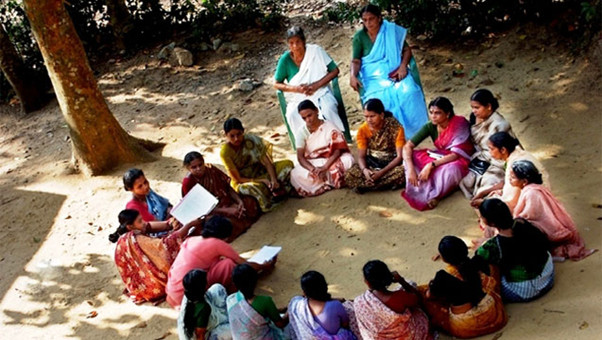

In the heart of Kerala, a state on the southwestern coast of India, a quiet yet powerful revolution is unfolding.
Launched in 1998, the Kudumbashree Movement—which means “prosperity of the family” in Malayalam—has grown into one of the largest and most effective women’s empowerment and poverty eradication programs in the world.

With a population of about 35 million, Kerala is home to roughly 17 million women—and more than 4.5 million of them are part of Kudumbashree’s vast network of self-help groups.
Through this grassroots movement, women have come together to gain financial independence, start small businesses, take leadership roles in their communities, and challenge long-standing barriers to equality.
What began as a basic policy initiative has evolved into a people-powered transformation that continues to reshape Kerala’s social and economic landscape from the ground up.
The birth of Kudumbashree
Named one of the ten paradises of the world by National Geographic Traveler, Kerala is a spectacular tourist destination. Boasting pristine sandy beaches, lush tea plantations, tropical greenery, and a rich cultural heritage, it has earned for itself the appellation “God’s Own Country.”

However, behind this lush “elysian field” lies another world: one of dire poverty. It’s that deep-rooted historical problem that the Kudumbashree Movement set out to address.
Kudumbashree was conceived in 1998 as a joint initiative by the Government of Kerala and the National Bank for Agriculture and Rural Development.
The project emerged in response to the dire need for a long-term approach to local development—one that would not only reduce poverty but also bring lasting improvements to the lives of poor families, with a focus on the women who had been left out of economic and social progress.
Kudumbashree’s vision transcends merely thinking of poverty as a lack of money. It defines poverty as people lacking the opportunity to realize their full potential as human beings, and with it, the ability to forge their unique identity and destiny.
Kudumbashree set out to build a strong collective voice among women. Through shared action and support, these marginalized citizens began playing a more active role in shaping their communities.
Tackling poverty through teaching entrepreneurship
Kudumbashree’s primary objective is to enable women to break the cycle of poverty by teaching them how to create self-reliant communities.
Through this initiative, women gain better access to vocational training to improve their employability. They are also encouraged and trained in how to become entrepreneurs and participate in micro-enterprises.
The fundamental idea is to help women step up in leadership roles, so they can make meaningful contributions within their communities. To this end, Kudumbashree’s approach integrates financial support, skill development, and grassroots organization.
This model creates a strong foundation for long-term improvements in economic opportunity. The participants gain equal access to resources and decision-making. They also experience a stronger sense of belonging and dignity for all members of the community.
Local control: the decentralized Kudumbashree model
Critical to Kudumbashree’s success is its decentralized structure, which allows participating women to control the implementation of the program in their own communities.
The program lives within a three-tiered system: Neighborhood Groups, Area Development Societies, and Community Development Societies.
While adhering to guidelines set by the state, each tier operates autonomously, so the selected initiatives can be tailored to the local community’s unique needs.
Neighborhood Groups
The smallest and most basic unit of Kudumbashree is the Neighborhood Group (NHG), which serves as the fundamental building block of the entire movement. An NHG comprises 10 to 20 women from families faced with various types of social and economic vulnerability.
These families are identified through nine non-economic risk factors, such as living in thatched houses, lacking access to clean water or sanitation, including illiterate members, lacking adult employment, or including young children under five.
NHGs are responsible for managing savings, loans, and community-based projects. They also offer a platform for women to share their challenges, discuss ideas, and identify new opportunities for economic activities.
Area Development Societies
At the ward level, which is a local administrative division within a village or town, Area Development Societies (ADS) bring together several Neighborhood Groups under a common umbrella.
ADS units provide practical support, such as helping with training sessions, keeping financial records, and submitting reports to local authorities. They make sure that the programs launched by NHGs are carried out effectively and benefit the wider community.
Community Development Societies
The largest organizational unit, the Community Development Society (CDS), operates at the panchayat (village council) or municipal level.
CDS units link together multiple ADS groups. They help manage resources and provide guidance for aligning local initiatives with the broader goals set by the state-level mission.
Success from the ground up
Though initiated and supported by Kerala’s government, the metamorphosis of the Kudumbashree movement did not result from a top-down government policy or foreign aid.
Rather, the engine that powered Kudumbashre’s amazing success has been the ordinary women of the villages—women who once struggled to make ends meet. Many of these same women are now successful entrepreneurs, community leaders, and architects of their own destiny.
Amazingly, Kudumbashree has empowered more than 4.5 million women in Kerala, resulting in one of the largest women-led networks in the world.
 [
[Empowerment through employment and funding
One of Kudumbashree’s most remarkable achievements lies in the broad range of micro-enterprise job opportunities it has created, particularly for impoverished families and women across Kerala.
The range of businesses is as varied as the women who run them. Some start food-based ventures, such as making pickles and snacks or setting up catering services for local schools. Others move into tailoring, handicrafts, soap-making, or running small retail shops.
In some communities, women have banded together to form collective farming groups that grow vegetables or mushrooms for local markets. With training and access to credit, these businesses often grow from modest beginnings into reliable sources of livelihood.
Celebrating enterprise and impact
The government recognizes outstanding efforts through awards and public acknowledgment of both individual and group achievements. These moments of recognition, in turn, inspire others to take initiative and build businesses of their own.
These businesses are often modest one-person efforts, but to the women who derive meaning and an income from them, they are literally life-sustaining.
Microfinance: a cornerstone for Keralta women
So how do these enterprises come to be? Enter Kudumbashree’s master stroke: microfinance!
For many women in Kerala, access to even small amounts of capital can be life-changing. Kudumbashree’s community-based microfinance model, rooted in trust and collective effort, gives women control over their own financial futures while strengthening the social fabric around them.
How it works:
- Kerala women create pooled funds through their Neighborhood Groups, which act as local savings groups. Members contribute small amounts—sometimes as little as ₹10 (about 12 cents)—which accumulate into a common fund. Over time, this creates a reliable source of capital for short-term needs like school fees, medical bills, or household repairs.
- These pooled savings allow the groups to open bank accounts—a first step into the formal financial system. For many members, this is their first-ever bank account, a magic key that gives them access to financial tools and literacy training. This step is particularly powerful for rural women who were previously excluded from institutional banking.
- Members approve and manage the loans themselves. Instead of a distant loan officer, it’s the group members who decide who receives a loan, how much, and under what terms. One woman might borrow to buy a sewing machine for tailoring work, while another might invest in vegetable farming. If repayment falters, the group steps in with support and solutions, not penalties. This peer-support system encourages trust, accountability, and responsible borrowing.
- Over time, well-functioning NHGs become eligible for larger public and private bank loans. Members use these larger loans to start or expand small businesses—like running a poultry farm or setting up a catering service. Others use the funds for building a better home for their families, covering health care expenses, or paying for their children’s higher education or vocational training.
As of January 2023, Kudumbashree’s Neighbourhood Groups (NHGs) have accumulated the equivalent of almost $10 billion USD in various banks across Kerala. This incredible sum reflects the collective savings of Kudumbashree members, pooled over the years. It is astounding that these savers are mostly women from low-income backgrounds.
Beyond business: building social capital
Kudumbashree’s microfinance model differs from traditional microfinance by emphasizing not only economic transactions, but also relationships, trust, and community cohesion. Social capital, in other words.
Unlike conventional microfinance, which usually treats borrowers as isolated clients, the Kudumbashree approach cultivates a sense of collective ownership and long-term collaboration. The participating women are not just recipients of credit—they are planners, problem-solvers, and leaders within their communities.
This holistic model opens up a much broader playing field for entrepreneurship. It encourages capitalizing on traditional knowledge and practical skills in farming, food production, natural medicine, education, housing, local services, and cottage industries—areas often overlooked by mainstream economic programs.
Women-led enterprises: the heart of local economies
The true depth of the Kudumbashree story lies in the lives it has transformed. From farming collectives to tailoring units, from community kitchens to health services, women across Kerala are not just building sustainable livelihoods—they are reshaping what development truly means.
Behind the impressive scale of Kudumbashree’s impact are thousands of stories of women transforming hardship into opportunity. Kudumbashree women don’t just create jobs. They regenerate their communities.
Here’s a sampling:
Stitching together livelihoods: the textile boom
Tailoring and garment production have emerged as significant sectors of employment within the Kudumbashree network. Numerous Kudumbashree-run units across Kerala produce school uniforms, traditional attire, and clothing for government programs.

Women receive comprehensive training in design, sewing, and quality control, which equips them with the skills to establish their own tailoring businesses.
In several communities, women have transformed existing structures into bustling tailoring cooperatives. These initiatives provide sustainable incomes and contribute to women’s empowerment throughout the region.
Proud to serve: initiatives in service industries
The movement hasn’t stopped at goods—it’s also transforming services. Some examples:
- Community kitchens (Janakeeya Hotels): These low-cost canteens serve nutritious meals to the public while employing local women.
- Waste management: Kudumbashree units handle waste collection and recycling in several towns, thereby contributing to public health and sustainability.
- Home health care: Some groups now provide palliative care and nursing services for the elderly. Members create and maintain these vital services by offering dignified employment to local women.
Kitchen to commerce: the rise of food micro-enterprises
Generations-old recipes and kitchen skills have become the backbone of new food processing businesses. Women produce pickles, banana chips, spice mixes, and ready-to-cook meals in certified hygienic units. These products are sold through fairs, Kudumbashree outlets, and even government programs.

For many women, this is not just about the income. It’s about seeing their names on a label and their labor valued in the marketplace.
From landless to leader: Bindu’s farming success
One striking personification of Kudumbashree success is a slight and unimposing woman named Bindu. Born into poverty and long denied access to land or a stable income, Bindu once struggled to afford even a single meal a day.
Today, thanks to Kudumbashree’s support and her own grit, she farms 26 acres, owns a two-story home and multiple vehicles, and is able to store enough rice to feed her family for a year.
But Bindu’s story doesn’t stop with personal success. She now trains other Kudumbashree members to operate farming machinery, helping them to break into a male-dominated field. “When I first started, people laughed,” she says. “Now they come to me for advice.”
Agriculture: cultivating more than crops
Across the state, Kudumbashree women are bringing barren land back to life. From organic vegetables and spice cultivation to floriculture and dairy farming, these small-scale initiatives not just provide stable income but also restore food security and sustainability in local communities.
Many of these ventures combine traditional wisdom with modern techniques, like integrated pest management and seasonal rotation. Others revive heirloom crops or turn collective farming into a form of social renewal.
Rebuilding in crisis: women on the frontlines of society
Kudumbashree’s power as a people’s movement shines brightest during times of disaster.
In the 2018 Kerala floods, members stepped in swiftly. They organized community kitchens, distributed essentials, and helped rebuild homes. Again, during the COVID-19 pandemic, they manufactured masks and sanitizers and spread vital health information.
These women are not only entrepreneurs—they are first responders, public health educators, and pillars in their communities.
Remaining challenges
Despite their expanding roles in business, governance, and public life, Kudumbashree women continue to face obstacles.
Gender bias remains prevalent in both public and private spheres, while religious and caste-based hierarchies often reinforce subordinate roles for women. Many are still expected to shoulder full domestic responsibilities alongside their professional work.
Meanwhile, violence against women—including harassment, dowry-related abuse, and suicide—continues to cast a shadow over these hard-won gains.
And yet, from this crucible of complex social pressures a new generation of courageous women is emerging—women who are not just breaking the mold but reshaping it entirely. Their persistence is helping redefine what is possible for women in Kerala and beyond.
Building a future on women’s terms
As our report has shown, Kudumbashree goes far beyond traditional poverty relief. It ignites personal empowerment at the community level and sustains it through collective action.
Through its unique combination of economic opportunity, democratic participation, and social support, this development model has made it possible for millions of women in Kerala to climb out of generational poverty and claim control over their lives.
What’s more, this successful model is now seen as a global benchmark for sustainable development.
As the model spreads beyond Kerala, it offers inspiration as well as instruction. The Kudumbashree Movement demonstrates that when social and economic policy is rooted in lived experience and the tools of progress are placed directly into the hands of those most affected, transformation is not only possible, but unstoppable.
Kudumbashree does not just lift women out of poverty. It gives them the tools to build a future on their terms, one village at a time.
Leave a Reply