

These days, school choice is more important than ever for parents searching for quality educational communities for their children.

Public schools have their issues. They range from physical and emotional safety questions, educational quality concerns, and nowadays even ideologically tinged curriculums in some schools that are at odds with parental values.
Private schools are costly and each has its own individual curriculum and teaching values that vary from school to school.
These are just a few reasons why today’s educational climate is ripe for innovative new models. Apogee Schools is a relatively new educational model that is well worth checking out.
Tim Kennedy and Matt Beaudreau, the founders of Apogee Schools, are on fire with their mission of “reseeding freedom by disrupting education.”
But what does that catchphrase mean? Let’s take a look.
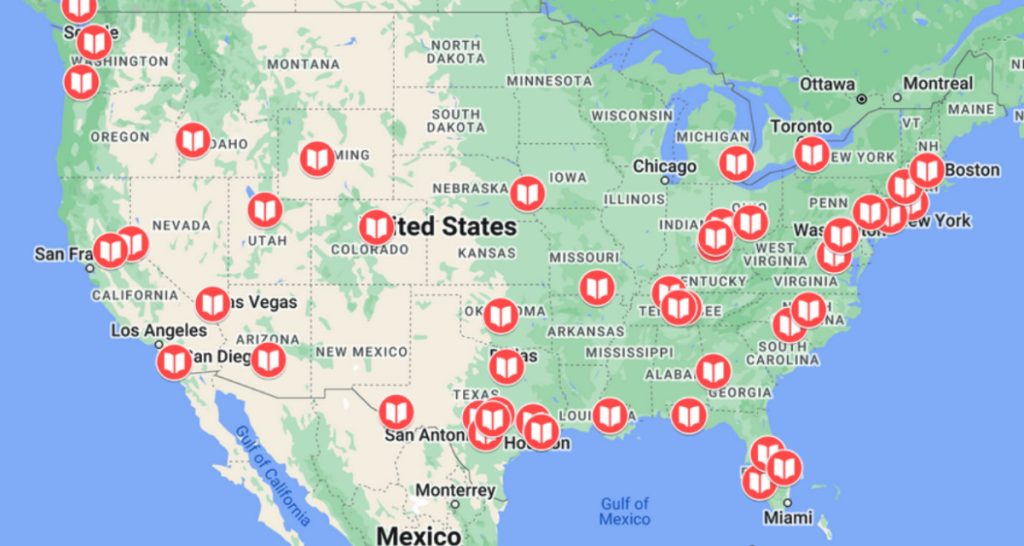
Since 2021 Kennedy, Beaudreau, and their team have helped launch 50 Apogee Schools, 49 in the U.S. and one in Australia. Many more schools are in the planning stages. They envision their movement as no less than the future of K-12 education in America.
The rapid and recent proliferation of Apogee Schools is a remarkable accomplishment that challenges, with each new school launch, what the founders assert is a crisis of epic proportions in American public education.
Backgrounds of the founders
A former Green Beret and mixed martial arts fighter, Kennedy’s background includes television, where he has hosted several shows. His dynamic personality shines in his leadership role with Apogee Schools.
Beaudreau’s background includes two decades as an educator in the corporate world. He passionately believes in building educational environments that encourage critical thinking, personal responsibility, and creative freedom.
A system that creates worker bees, not critical thinkers
Kennedy doesn’t mince words in his critique of public education. “What is the basis for public education now is to build consumers and to build lemmings. You know, [John D.] Rockefeller, the man who founded, who started all public education, he was quoted as saying, ‘I don’t want smart people. I want people smart enough to work for me.”
Contrasting Rockefeller’s stated attitude toward public education, Beaudreau points out that the authors of our nation’s founding documents, including the Declaration of Independence, “had far less access to information, and they were far more educated.”
“Although teachers do care and work very, very hard, the institution is psychopathic. It has no conscience. It rings a bell and young man in the middle of writing a poem must close his notebook and move to a different cell.”
– John Taylor Gotto, New York City Teacher of the Year
But “what is education doing right now?” he asks rhetorically. “It is doing nothing. It is building nothing. It is building no one that is going to go out and change the world.”
He takes exception to the idea of some critics of public education that the system is broken. Rather, he believes it is “working exactly as it’s designed” and that that design falls woefully short in key areas such as leadership, critical thinking, and real-world problem-solving.
Strong words, these. It is easy to critique a system for its failures, but it is far harder to replace one that still has its powerful advocates and, moreover, one that is free. But the Apogee founders have shown they are willing to put in the work needed to succeed.
Regarding free public education, it should be noted there is a catch, Beaudreau asserts. To illustrate, he sketches a free food analogy.
He compares free public schooling for children to free food. “If I realized that my kids had free access to food…and at one point, I learned that in each bite of that food, there was just a little tiny bit of poison that was in there, I’d go to any length to do whatever I needed to do, to make sure that they were getting food that wasn’t poison.”
Is there a “tiny bit of poison” that children consume in their public schooling? Some would argue there is more than a little.
It’s the parents who see this who reach out to Apogee for alternative educational solutions for their kids, Beaudreau and Kennedy point out. But that “poison” is not just embedded in curriculum content. Rather, it is systemic, they argue.
The dictatorship of public schools
Beaudreau notes that “schools will talk about the triangle all the time…where you’ve got the school over here that’s partnering with the student and the parent.”
But “it’s not a partnership, it’s a dictatorship,” he asserts.

Kennedy illustrates the critique: “I need you to sit there for six hours. I need you to look at that whiteboard and do the things that I’m telling you to do on that board…. Nothing sounds more tortuous than doing just that.
“And the thought of me asking one of my children to go and do that is absolutely insane,” he adds. The ease of outsourcing education to a government entity because it’s the norm and the easiest path to take carries with it a huge risk, which is the failure to truly educate our children to be strong communicators, critical thinkers, and problem solvers adept enough to navigate real-world environments, the Apogee founders argue.
Once parents come to grips with that stark possibility and are brave enough to consider the possible consequences for their children, they must “figure some things out,” Beaudreau notes. And that figuring out is not so easy.
Apogee empowers families
Beaudreau sees Apogee Schools empowering families to step away from traditional schooling in favor of a community that values freedom, critical thinking, and real-world applications.
He emphasizes the importance of building this new system not as an attack on traditional schools but as a constructive effort to redefine normalcy in education. His ultimate aim is to spur a deep cherishing of educational freedom for children and their families, making it the new norm for future generations.
But beyond Apogee’s overarching philosophy, what is a day in the life of an Apogee “hero” look like? Apogee kids are called heroes, by the way, because their education is viewed as classic heroes’ journeys: adventures with daily challenges to overcome and milestones to reach.
What is the Apogee program?
One of the first questions parents who are looking for alternatives to public education ask is, what is the Apogee program? Its curriculum, if you will, though that term is not part of Apogee’s lexicon.
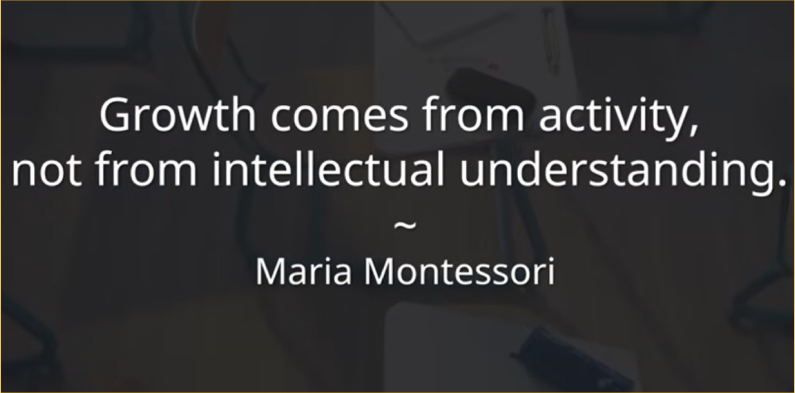
“We’re a hybrid between project-driven learning and Socratic education,” Kennedy explains. “And what that looks like in a studio, in a classroom, is learner-driven. The students, the heroes in that classroom, they are the ones that are driving everything.”
Regarding specific subjects, learning the arts of verbal and written communication, cultivating a love of reading, and daily addressing one’s physical education and personal health are non-negotiable elements of an Apogee curriculum.
While people often think of school in terms of subjects, it encompasses much more, Kennedy says. Schools involve relationships, communication, and obedience training, even though these aspects are not always apparent, he notes.
A typical Apogee school day
A typical day at an Apogee School includes engaging in Socratic conversations aimed at improving how students interact with and communicate with others. Apogee Schools emphasize the importance of understanding civil discourse and engaging thoughtfully with others.
Kennedy also stresses the importance of critical thinking, not just as a slogan but as a central focus. Additionally, he mentions reading and writing as fundamental skills, taught through actual practice rather than sticking to rigid, sometimes developmentally inappropriate standards.
He criticizes the conventional points-based systems for reading. He advocates for an approach where students learn to love reading because it can profoundly change their lives, not just to score well on tests.
Regarding academic content, Kennedy states that the curriculum at his schools offers flexibility and choices in how academic subjects are tackled, from computer programs to textbooks and practical projects. He believes that linking academics to project-based learning enhances effectiveness and retention.
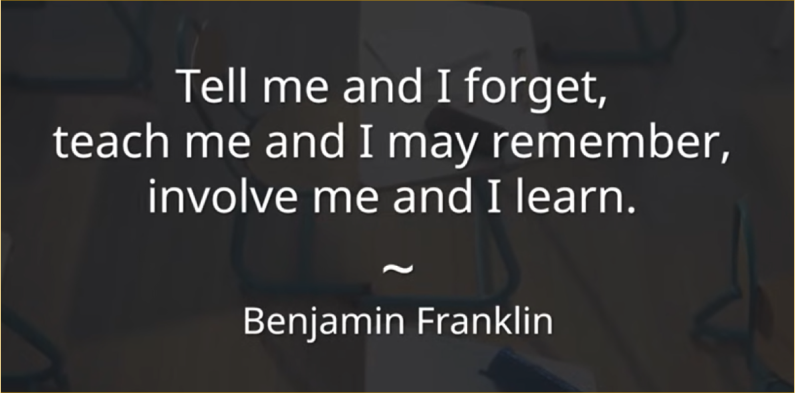
“We’re going to give them a choice and we’re going to give families a choice on exactly how they tackle those academic buckets from potentially computerized programs to using textbooks, if that’s what you want, to little mini projects that are a microcosm of a real-world application of a specific subject,” Kennedy explains.
“Specific focused academia time is a part of the day. More learning happens and in fact, that academia becomes more effective when it is tied to projects. Projects are a huge part of the day. There is always a themed project going on that takes about five or six weeks with a very specific exhibition of work to be at the end.”
Writing is another core element of an Apogee education.
“What kind of writing matters?” Beaudreau asks. “Writing that allows you to get your thinking out or writing that communicates a very specific idea like writing an email, writing ad copy. Nobody writes essays other than academics.”
Apogee parent Mike Buoy explains further: “So all of a sudden you now have all these real-world challenges that people deal with on a day-to-day basis as opposed to, I need to write a persuasive essay. Instead, it’s…well, let me write an email to this person asking for an introduction.
“And through that process, they’re learning all that persuasive conversation, for example, but they’re doing it in a way that actually matters to them.”
Another core element of the Apogee Schools code is understanding that responsibility precedes freedom, Beaudreau notes. “On campus, these young heroes have the responsibility to take on their own individualized academic goals. And they’re going to work on their own academic goals with coaches [and] as they work through all of these academic problems they’re going to set their own responsibilities, their own goals. And as they achieve those, then it unlocks the freedoms on campus, because that’s how life actually works. You’ve got to take care of your responsibilities and it opens up more freedoms.”
Kennedy also underscores the importance of physical education, which is a non-negotiable part of every Apogee day. He advocates for education that not only focuses on academic success but also on making students physically healthy through disciplined diet and physical activity.“Real physical education is not negotiable for us,” he says. “So, physical education is a bucket every single day. Free time and free play is a bucket every single day. Responsibilities on campus are a bucket every single day.”
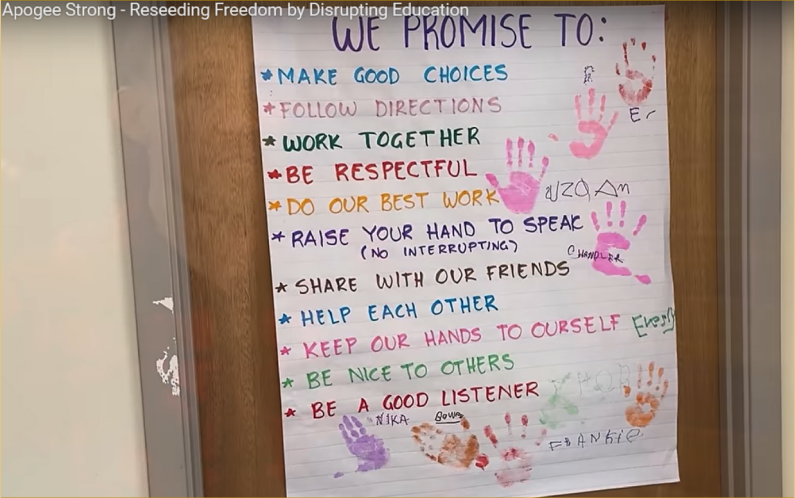
“Look, we have no desire to burn down all of the public schools,” Beaudreau concludes. “This is not an attack on the schools. This is not an effort to tear anything down. It is the call to start a revolution by building up. We want to build up our communities. We want to build the alternative. We want to build the place that inspires the young heroes to be better. And as we build more, then we render the old obsolete.”
“So again, this is not an attack on schools. This is not an attack on teachers, not an attack on administrators. This is a call to revolutionize the building of something that will bring back the seeds of a free society by disrupting education. And we’re inviting you to join us, not in the process of tearing down, but in the process of building the new that saves the heroes.”
Kennedy adds: “We want to be a part of the mission of this bloodless revolution of building and changing and shifting the culture to this new reality so that future generations…are born into a society that understands what freedom looks like.
“And for them, that’s their norm. I want to be a part of that mission of raising the baseline of what normal looks like now for our culture.”
Part of a larger educational movement
It is important to note that Apogee Schools with its founders’ ambitious dreams of recapturing true educational freedom are part of a larger movement in America toward alternatives to sending kids through the legacy public school system. Faith-based schools, Montessori schools and charter schools all are part of this effort, which, it can be argued, are moving K-12 education in America toward nurturing not only the intellect but also the emotional, social, and spiritual dimensions of the child.
The bottom line is, there is a varied and growing range of alternatives to public education. Take a look around your own community. You might be surprised at what you find.
Apogee Schools FAQs
Who are the educators at Apogee Schools?
The teachers and mentors at Apogee Schools come from diverse backgrounds and bring various professional and life experiences to the educational environment. These include individuals with expertise in different fields such as education, business, finance, and even physical training.
What are their credentials?
Apogee educators bring a wide range of expertise to their positions. The emphasis is on real-world experience and success in various professional arenas, which they bring into their teaching and mentorship roles.
Is there an online/homeschooling component to Apogee Schools?
Apogee Schools offer a hybrid model of education. There is a strong emphasis on in-person, on-site experiences that are designed to integrate learning with real-life applications. Additionally, there are online mentorship programs available, such as Apogee Strong for young men and women, which focus on personal development through online interactions.
What is the range of tuition at Apogee Schools?
Tuition varies. However, here are two examples:
The Apogee School for the Gifted in Indiana offers a competitive tuition rate of $14,640 per year, which is significantly lower than the national average for private nonsectarian K-12 schools.
The current annual tuition for Apogee Cedar Park near Austin, Texas is $14,000. This can be paid in 10 monthly installments of $1,400. The school also offers discounts for siblings, full payments, and first responders.
Are Apogee Schools accredited?
In this short YouTube video, Matt Beaudreau addresses Apogee’s views on accreditation.
As a side note, more than 50 short videos covering a wide range of Apogee-related topics are posted on YouTube.

Leave a Reply