
In 1990, Minneapolis family law attorney Stu Webb hit a wall in his career.
Webb had spent almost two decades fighting for clients in courtroom battles that ultimately left families shattered. He was done with divorce litigation. But unlike others who might have retired or moved on to a different career, Webb wasn’t ready to give up on his profession or the families he served.

Instead, he made what proved to be a creative and workable ultimatum: he would no longer go to court for any of his clients. Instead, he would work with other professionals to find a less-adversarial way through the divorce process.
What grew from this ultimatum was a movement that has shifted the divorce process from its traditional adversarial nature to a pathway of hope. Today, the movement begun by Webb is recognized as a professional area within the legal field called collaborative divorce.
The costs of the traditional divorce process
Anyone who has been through a divorce knows that the divorce process is costly, both financially and psychologically. A traditional litigated divorce can take many months and cost tens of thousands of dollars, depending on the complexity of the case.
Apart from the financial cost, there is a deeper psychological toll to those involved. The family—which begins as a single unit—becomes something the legal system has to dismantle.
The world of litigation is adversarial by nature. Spouses hire attorneys who each take a side and prepare for battle. A judge decides who is right, who is wrong, who wins, and who loses. If there are children involved, a critical long-term aspect of their relationship can become collateral damage: the co-parenting relationship.

Probably the biggest cost in a traditional divorce process is paid by those who end up caught in the middle: the children. Children who are pitted against a parent or used as pawns in a game of who-gets-what pay the highest price mentally and emotionally.
Research shows that children in high-conflict divorces are more likely to struggle with anxiety, depression, and other adjustment problems. It takes the savviest of parents and professionals to support children through a divorce.
The birth of collaborative divorce
Webb’s 1990 ultimatum to himself was born from compassion for the families he had spent almost two decades serving, as well as his own reflection on the weaknesses of the litigated divorce process.
He had been practicing law for over two decades, during a period when the rate of the no-fault divorce—a divorce where neither spouse is accused of or must prove marital misconduct—was rising in the United States. Additionally, Webb went through his own divorce in the mid-1970s, which gave him first-hand experience of the process.
In Webb’s own words:
“In 1989, I had been a divorce lawyer for about eighteen years—and was getting pretty sick of it. I saw what the adversarial court battles that were the focus of divorce were doing to my clients, and I knew the resulting negativity was having an effect on me, too. …
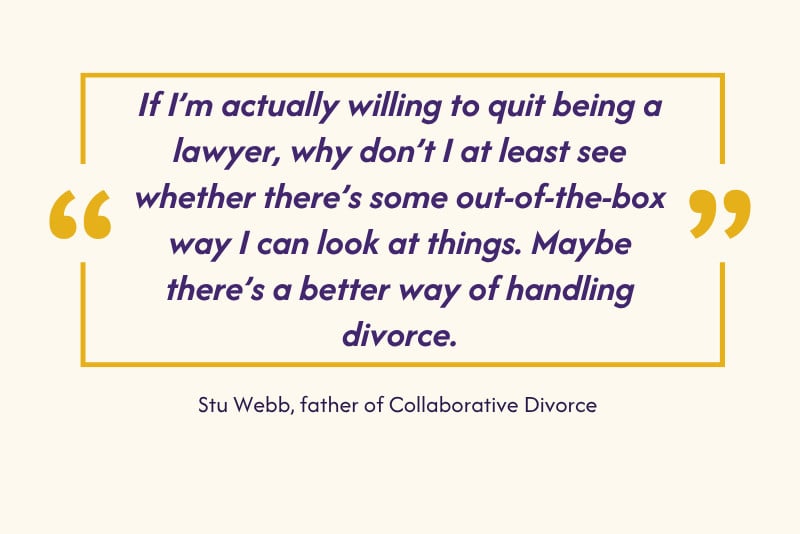
“As a divorce litigator, I’d felt for a long time that I was living in a siege mentality, merely waiting for the next battle to start, and finally I got to the point where I was ready to quit the practice of law. I enrolled in a college and was ready to start educating myself for a new career when I had one last thought about practicing law: ‘If I’m actually willing to quit being a lawyer, why don’t I at least see whether there’s some out-of-the-box way I can look at things. Maybe there’s a better way of handling divorce.’”
Webb began looking for creative alternatives for resolving divorces. During a particularly challenging litigation case in late 1989, he had an inspiration:
“… in the midst of one of those awful hearings, it occurred to me that there should be settlement-only specialists available for divorcing couples, specialists who work with the couple outside the court system, and who would turn the case over to trial lawyers if and only if the settlement process failed.
“That, in a nutshell, was the birth of Collaborative law.
“On January 1, 1990, I declared myself a Collaborative lawyer—the first, and only, one.”

Growing the movement
Knowing that his work as a Collaborative lawyer would die on the vine without other professionals involved, Webb began reaching out to friends, colleagues, and acquaintances to spread his ideas.
According to collaborative-law histories, on February 14, 1990, Webb wrote an extensive letter to then Minnesota Supreme Court Justice A. M. “Sandy” Keith detailing his ideas on a collaborative divorce process and its advantages over litigation and mediation. In his reply to Webb’s letter, Keith encouraged him to move forward with this new initiative.
By the end of 1990, eight other attorneys had joined Webb in practicing Collaborative divorce law. Over the next few years, other legal and mental health professionals drew similar conclusions and began to network and collaborate to change the divorce process. And the movement grew.
Webb continued to practice family law before retiring in the early 2010s. Prior to his retirement, he wrote the book on collaborative divorce: The Collaborative Way to Divorce: The Revolutionary Method That Results in Less Stress, Lower Costs, and Happier Kids—Without Going to Court (co-authored with Ronald D. Ousky, published in 2007).
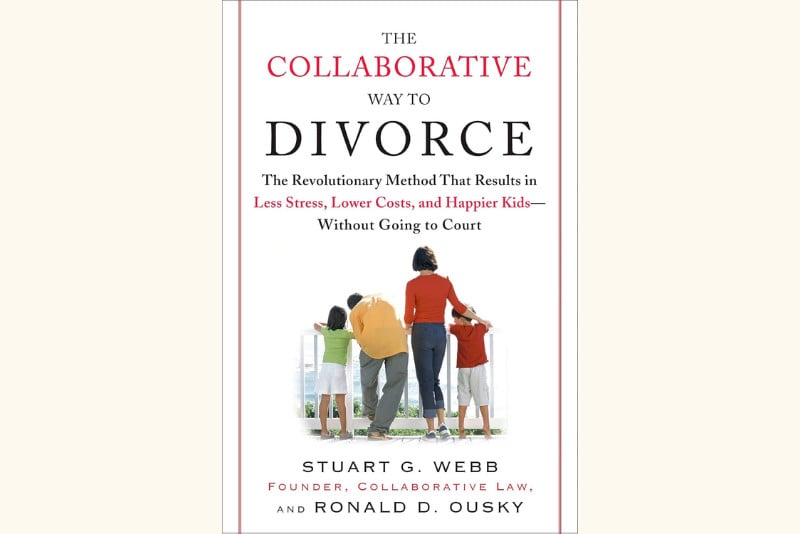
In his book, he sheds light on the hope embedded in the collaborative divorce process: “The Collaborative Way to Divorce isn’t about ‘going easy’ on your spouse. It’s about getting what you want while ending up with less expense, less stress, and happier kids, without going to court.”
What is collaborative divorce?
Collaborative divorce is a formal legal process in the area of family law where spouses come to a divorce agreement through negotiation instead of litigation.
Each party hires an attorney trained in collaborative divorce. The parties, attorneys, and other professionals work together to negotiate the terms of a divorce settlement. The process focuses on communication and collaboration over adversarial tactics and legal maneuvers.
The hallmark of the process is that both parties sign a participation agreement committing to navigating the divorce process without litigation. Rooted in Webb’s initial personal ultimatum, this is a legal agreement with significant consequences if either party decides to break it.
If one party does choose to pursue litigation, both attorneys withdraw their counsel and the spouses must hire new attorneys and start the divorce process over.
The collaborative divorce team
A key part of the collaborative divorce process is the team that comes together to support the family in reaching a resolution.
A collaborative divorce team is made up of each spouse’s attorney, plus experts who are brought in on an as-needed basis. These experts include financial experts, child specialists, and mental health professionals. Teams are created based on the unique needs of each family.
Families with complex financial situations might hire a financial professional to help analyze financial assets and educate them on the impact of their settlement options post-divorce.
In addition to their professional financial certifications, some collaborative-practice groups (such as the DC Academy of Collaborative Professionals and Collaborative Divorce Illinois) require these professionals to have mediation training, basic collaborative training, and additional collaborative-practice education in order to participate on a collaborative divorce team.
Families with children may choose to include a child specialist in their collaborative divorce process.
Unlike a guardian ad litem or child representative, who is appointed by the court to advocate for the child’s best interests in a litigation case, the child specialist is a neutral mental health professional who works with the collaborative team and parents. These specialists’ goals are to help both parents understand what their children are experiencing in the divorce process and to guide the development of a child-first parenting plan.

Some collaborative divorce teams may include a divorce coach or a mental health professional to help spouses manage their emotions, improve communication, and stay focused on productive problem-solving. Although not considered part of the team, each spouse may also seek out a counselor or therapist to support them through the divorce.
While it might appear costly to hire so many experts, the costs of hiring for professional advice and mediation skills for critical aspects of the divorce can often speed up the process, which saves time and money in the long run.
Additionally, working with multiple professionals in a collaborative way gives greater control to both parties. It allows them to create the settlement that best suits their needs instead of yielding to boilerplate decrees often dictated by the courts.
Collaborative divorce vs. mediation
Although collaborative divorce professionals are trained in mediation and both processes are designed to keep a divorce out of court, the collaborative divorce process itself is not the same as mediation. There is a key difference in representation.
In mediation, the parties work with a neutral mediator to resolve their differences, but no legal advice is offered.
In a collaborative divorce, each spouse has their own attorney advising them through the process. A collaborative divorce may include a mediator as part of the team, but each party is well-supported by legal professionals.
Collaborative divorce is not for everyone
Although collaborative divorce might feel like a hope-filled pathway for all families going through divorce, it is not for everyone.
Because collaborative divorce requires both parties to participate actively and in good faith, it is not an appropriate process for situations involving domestic violence, abuse, or serious power imbalances.
Additionally, there is a certain financial risk to the collaborative divorce process that not everyone may want or be able to bear.
If the parties can’t come to an agreement or one party chooses to violate the participation agreement—even if it is the right thing to do for the situation—the collaborative divorce attorneys must withdraw from the case. Each party must seek new legal representation and essentially start the divorce process over, which is both costly and time-consuming.
Lastly, while the no-litigation participation agreement can help keep both parties engaged and accountable, it could unnecessarily tie up spouses who were not suited initially to work together in good faith.
A trained professional can help a spouse assess whether or not collaborative divorce is the right fit for their situation.
The impact of collaborative divorce on family law worldwide
Since Webb’s no-litigation determination in 1990, his work to develop the collaborative divorce process has had a significant impact on the practice of law worldwide.
According to the International Academy of Collaborative Professionals (IACP), collaborative divorce is now practiced in 23 countries on five continents. This professional non-profit organization, founded in 1989 as the American Institute of Collaborative Individuals, boasts 2,400 members and is but one of many local, regional, and global professional collaborative divorce organizations around the world.

The practice of collaborative divorce received international attention in 2023 when the IACP received a Nobel Peace Prize nomination for its work in conflict resolution.
Although collaborative divorce still represents a relatively small segment of the divorce market today, the idea is spreading beyond family law.
In a 2024 legal commentary posted in The Recorder on Law.com, authors Elisa Reiter and Daniel Pollack made the case that the collaborative divorce process could be translated to other legal areas including business, employment, intellectual property, health care, and environmental disputes.
Lessons learned from Stu Webb and collaborative divorce
What’s the take-away from family law attorney Stu Webb’s innovative ideas and his development of the collaborative divorce process?
Webb is an example of someone who refused to settle for the status quo of his profession. He chose not to run from the systemic problem he identified in the family legal system, namely the adversarial nature of the litigated divorce process. Instead, he used his professional strengths to collaborate with others and develop a completely new divorce process.
Webb came up with a creative solution that went well beyond his own profession: he realized that representatives of other disciplines could and should work together with attorneys to support families in the divorce process.
The result? One man’s cross-disciplinary approach has become recognized worldwide and has shifted how many attorneys practice family law today.
Editor’s Note: This article is presented in the spirit of information-sharing and is not intended to be used as legal advice. Please consult with a legal professional if you are contemplating divorce.