

For decades, a harrowing scandal has plagued towns across the United Kingdom. The long, sad tale has exposed not only the depths of human depravity but also the staggering apathy of those entrusted with safeguarding the vulnerable.
Grooming gangs, often composed of men of Pakistani and South Asian descent, systematically preyed on thousands of underage girls—predominantly white, working-class British girls—who were treated as expendable, their suffering ignored for the sake of political convenience.
Yet, amid this horror, forces of good have risen to break the silence, demanding justice where institutions failed. The fight against these grooming gangs is no longer just a battle against criminals—it is a battle against systemic neglect, willful blindness, and a culture that allows evil to fester unchecked.
Courageous individuals, like former detective Maggie Oliver, whistleblower Jane Senior, and activist Tommy Robinson, have stepped forward as modern-day Davids, taking on the Goliath of organized abuse and institutional complicity.
Despite threats, smear campaigns, and immense personal cost, they and others have refused to back down, proving that when good people take responsibility, change is possible. True justice demands social responsibility—from both institutions and individuals willing to challenge corruption, speak out against wrongdoing, and protect the most vulnerable in society.
As a qualifying note, it’s important to recognize that child sexual exploitation in the UK is not confined to any single demographic. One report cited by The Times indicates that perpetrators cover the gamut of UK demographic backgrounds.
The scale and scope of UK’s predatory grooming gangs
Regardless of their origins, the numbers are staggering. The Centre of Expertise on Child Sexual Abuse estimates that up to 500,000 children—about one in 28—are being sexually abused each year in the UK. “That is a number to shock people of any political persuasion,” noted Times journalist Tom Calver.
The sad truth is that predation on young girls is a pervasive issue in Britain. Yet for years, these crimes—no matter who committed them—were ignored, minimized, or deliberately concealed by authorities more concerned with optics than justice.
In cases involving Pakistani and South Asian grooming gangs, the racial and cultural dynamics of this situation further fueled official reluctance to intervene. Fears of being labeled racist, coupled with the stranglehold of political correctness within law enforcement, social services, and local councils, contributed to a culture of inaction. Evidence mounted, but victims were abandoned.
Now, however, the tide is turning. Thanks to the relentless efforts of those who refuse to look away, more survivors are being heard, and more perpetrators are being held to account.
Taking social responsibility means not just acknowledging a crisis but committing to its eradication. It means standing with the whistleblowers, the survivors, and the truth-tellers who are fighting to dismantle these networks of abuse, no matter how powerful their enablers may be.
A crime and cover-up of epic proportions
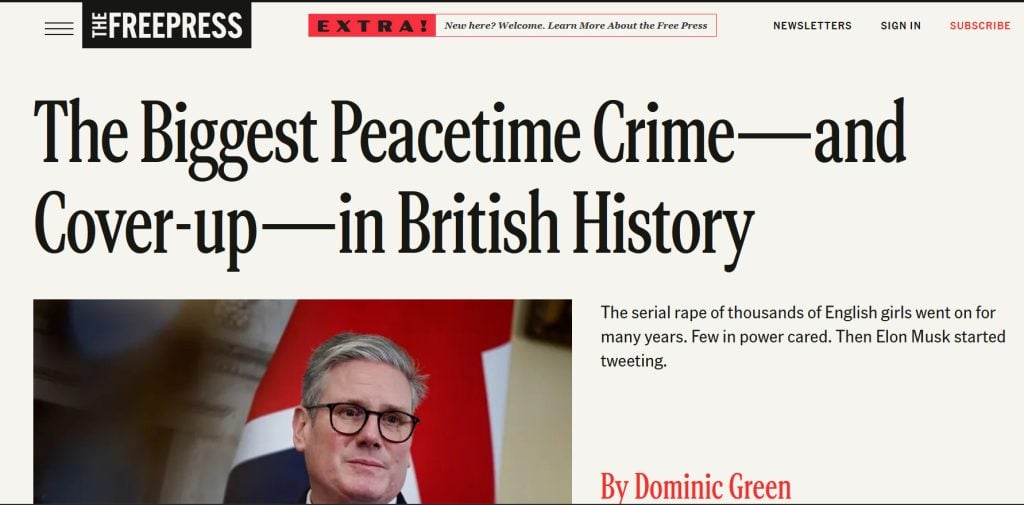
In a searing indictment, The Free Press called the grooming gangs scandal “The Biggest Peacetime Crime–and Cover-up–in British History.” The story details the systemic failures and deliberate inaction by British authorities, including social workers, local police, senior officials, and politicians, who either ignored or actively concealed these atrocities to maintain “community relations” and avoid accusations of racism or Islamophobia.
Those fears, along with deep-seated political correctness within law enforcement, social services, and local councils, led to repeated inaction, despite overwhelming evidence of the abuse.
“The grooming and serial rape of thousands of English girls by men of mostly Pakistani Muslim background…went on for many years,” Free Press journalist Dominic Green wrote in the piece. “It is still going on. And there has been no justice for the vast majority of the victims.”
The full extent of the grooming gang crisis is staggering. While Rotherham and Rochdale are the most infamous cases, similar abuse rings have been uncovered in Telford, Oxford, Newcastle, Keighley, and other towns.
Investigations suggest that at least 1,400 children were exploited in Rotherham alone between 1997 and 2013, but the true figure nationwide is likely in the tens of thousands.
The victims were overwhelmingly white, working-class British girls, many from troubled backgrounds, but this did not happen by coincidence. Testimonies from survivors and reports such as the Jay Report highlight how perpetrators saw these girls as “inferior” and viewed them as easy prey who could be groomed, abused, and discarded with impunity.
Some victims reported being called racial slurs by their abusers, reinforcing the stark racialized aspect of the crimes—an uncomfortable but undeniable reality that many officials and journalists long sought to avoid discussing.
Reports detail the depravity of UK grooming gangs
Reports such as the 2014 Jay Report and the 2022 Independent Inquiry into Child Sexual Abuse have outlined a pattern of abuse that persisted for decades.
Survivors describe being groomed, coerced, drugged, and raped, often passed around between groups of men. Many were taken to different cities, sold for sex, and subjected to brutal assaults, with threats of violence if they dared to seek help.
But when these victims did speak up, the institutions meant to protect them did nothing. Instead of being seen as children in desperate need, they were often dismissed as “troublemakers” or, even more disturbingly, as complicit in their own abuse.
Many police officers and social workers labeled them as “child prostitutes”—a term that should never have existed in the first place.
How fear and political correctness enabled the predators
The failure of institutions to intervene cannot be explained away as mere incompetence. A deep-rooted culture of political correctness played a major role in preventing action, as authorities feared that acknowledging the ethnic background of many perpetrators would lead to accusations of racism.
This fear, combined with a systemic culture of denial and avoidance, resulted in an extensive cover-up, repeated refusals to act, and the suppression of those who tried to expose the truth.
The most damning aspect of the grooming gang crisis wasn’t just the abuse—it was the willful inaction of those who could have stopped it.
The silence of the authorities
Internal police reports, leaked emails, and official inquiries have revealed a disturbing pattern: authorities knew what was happening but chose to do nothing.
- Police officers avoided arrests that could “inflame community tensions.” Some admitted they ignored leads to avoid accusations of racism.
- Social workers who raised concerns were silenced or threatened with disciplinary action.
- Local councils covered up reports, shredded documents, and suppressed investigations.
- Government officials ignored whistleblower warnings. Fearing political fallout, they failed to take more than token action.
A glaring example is current Prime Minister Keir Starmer, who served as Director of Public Prosecutions from 2008 to 2013. Under Starmer’s leadership, key prosecutions were stalled or dismissed outright, reinforcing the culture of inaction that allowed these crimes to persist. Even now, as Prime Minister, Starmer has offered only limited acknowledgment of the scandal. His government speaks of “lessons learned,” yet survivors and whistleblowers remain deeply skeptical.
Grooming gangs exploited this cowardice. Survivors later testified that abusers openly mocked them, knowing the system would never hold them accountable.
The price paid by whistleblowers
Those who spoke out faced severe consequences.
Sarah Champion, Labour Member of Parliament for Rotherham, was forced to resign from the shadow cabinet in 2017 after addressing the racial element of the gangs.
Andrew Norfolk, the Times journalist who exposed the scandal, faced smear campaigns and accusations of fueling racial hatred.
And police officers who challenged the cover-ups were threatened with professional ruin.
Media complicity and the courageous few
For years, major media outlets avoided reporting on grooming gangs. Even after the scandal broke, coverage was often cautious, sometimes even hostile toward those demanding justice.
It was independent journalists, whistleblowers, and survivors who forced the issue into public discourse. Without them, this crisis might have remained buried.
Britain’s institutions abandoned thousands of children to unspeakable abuse. They did so not out of ignorance, but out of fear. Yet, amid this widespread negligence and institutional inaction, a few individuals refused to look the other way. They risked everything to expose the truth.
Whistleblowers and survivors find the courage to act
It took the extraordinary courage of whistleblowers and survivors to finally drag the truth into the light. Among those who refused to stay silent were Margaret Oliver and Jayne Senior, two women who risked their careers and personal safety to expose the scale of the abuse.
Oliver, a former detective constable, was among the first to reveal how police forces deliberately neglected victims and failed to prosecute offenders. Senior, a youth worker, gathered overwhelming evidence of the crimes in Rotherham, only to be dismissed, threatened, and ostracized by the very institutions that should have been helping her protect at-risk children.
Maggie Oliver: the detective who resigned her job to tell the truth
Margaret Oliver joined Greater Manchester Police (GMP) in 1997, determined to protect the vulnerable. But as a detective, she witnessed how police ignored clear evidence of child exploitation, which allowed perpetrators to evade justice.
Working on the Rochdale grooming gangs case, Oliver saw young victims dismissed as “child prostitutes” and their abusers treated with leniency. She grew increasingly frustrated as officers failed to act on intelligence and dropped charges against key perpetrators. In 2013, when she realized this negligence was deliberate, she resigned in protest.
After leaving GMP, she became a vocal advocate for victims. In 2019, she founded The Maggie Oliver Foundation, which provides legal and emotional support to survivors.
Her whistleblowing efforts came at great personal cost. She faces backlash from former colleagues, threats, and media hostility. Today, she relentlessly continues to fight for urgent reforms to prevent more children from being abandoned to predators.
Jayne Senior: the youth worker who refused to look away
As coordinator of the “Risky Business” youth project in Rotherham, Jayne Senior worked with at-risk children. In that role, she quickly uncovered the widespread grooming of underage girls. Senior meticulously documented the abuse and repeatedly alerted authorities, but was ignored—or worse, warned to stay silent.
Despite threats and professional ostracization, Senior persisted. Her evidence was crucial in exposing the Rotherham scandal, which culminated in the 2014 Jay Report noted above. That bombshell report revealed over 1,400 cases of child sexual exploitation in Rotherham alone.
Even after the truth came out, local authorities continued to resist accountability. Like Oliver, Senior has faced intimidation but remains committed to justice.
Tommy Robinson’s role in exposing grooming gangs
While whistleblowers like Oliver and Senior worked within institutions, Tommy Robinson—a far more controversial figure—used confrontational activism to bring the issue into the public eye.
Robinson gained prominence by publicly denouncing what he saw as a politically motivated cover-up. He confronted officials, organized protests, debated media, and livestreamed outside courts where grooming gang trials were being held.
His 2018 arrest for contempt of court, after filming outside a trial in Leeds, became a flashpoint. He was sentenced to 13 months in prison, which sparked outrage among supporters who claimed he was jailed for exposing what the government refused to address.
Some argue that Robinson’s focus on the racial element of grooming gangs fueled division, while others credit him with pressuring authorities into taking the issue more seriously.
Regardless of where one stands on his methods, Robinson’s activism highlighted an uncomfortable truth: those who tried to expose grooming gangs—whether through official channels or activism—often faced greater consequences than the abusers themselves.
The courage of these three and others, including brave survivors, shattered the silence surrounding grooming gangs. Without their determination, the scale of this crisis might never have come to light.
Elon Musk shines a social media light on the issue
Elon Musk has emerged as an unexpected but powerful voice in exposing the UK’s grooming gang scandal. Using his platform on X (formerly Twitter), he has reignited global discussion on a crisis that many in the British establishment would rather ignore.
Musk’s engagement began when independent journalists and campaigners highlighted ongoing cases and pointed to police inaction and systemic failures. Unlike many public figures, he did not dismiss the claims.
Instead, he directly questioned how UK institutions allowed such widespread abuse to persist for decades. His posts, seen by millions, forced legacy media outlets—many of which had long downplayed the issue—to reengage.
His intervention triggered fresh demands for government accountability, with renewed calls for independent inquiries.
However, just as quickly, the establishment sought to discredit him. Some politicians and media pundits accused Musk of stoking division and implied that raising concerns about grooming gangs amounted to spreading hate speech.
Yet, Musk’s involvement has proven one thing: sustained pressure forces action. Once buried, the grooming gangs issue is now back in public discourse. The real question is whether this renewed attention will bring reform—or if the scandal will once again be swept under the rug.
The ongoing fight for justice for grooming gang victims
Despite multiple reports, convictions, and public inquiries, the battle against grooming gangs is far from over. Survivors still struggle for justice, authorities remain reluctant to act, and cover-ups continue.
Campaigners like Maggie Oliver and Jayne Senior continue their work, supporting survivors through legal battles, mental health assistance, and advocacy.
Meanwhile, alternative media and independent journalists have taken up the mantle of exposing new cases. Citizen journalists, once dismissed as conspiracy theorists, are now among the most reliable sources documenting ongoing failures. Unlike mainstream outlets that downplayed the issue for years, these independent voices have made it impossible for the authorities to pretend the problem doesn’t exist.
Good people must take social responsibility
Despite the heroic actions of whistleblowers and activists, the battle is far from won. Grooming gangs continue to operate. Survivors still face intimidation. Authorities still downplay, delay, and deny. The response from the UK government, even under increasing scrutiny, remains partial at best—driven only by external pressure, not by a genuine commitment to justice.
The fight against such entrenched corruption and indifference is not just a legal or political one—it is a moral one.
The story of the UK grooming gangs is a rallying cry for taking social responsibility—the need for ordinary people to stand up against evil, even when powerful forces would prefer they remain silent.
In abhorrent situations like this, the pressure must never stop. Because the moment it does, the battle is lost.

Leave a Reply