

AI technologies are transforming the academic landscape at a rapid pace. They offer unprecedented opportunities for personalized learning for students of all ages. And now, with the arrival of personalized AI tutors, education technology (EdTech) has become even more customizable.
AI-driven EdTech platforms are powered by intelligent algorithms that adapt to each learner. The term “intelligent tutors” refers to AI programs that act like personal teachers or tutors. These AI-powered tutors guide students through lesson material, answer their questions, and give feedback in human-like ways.
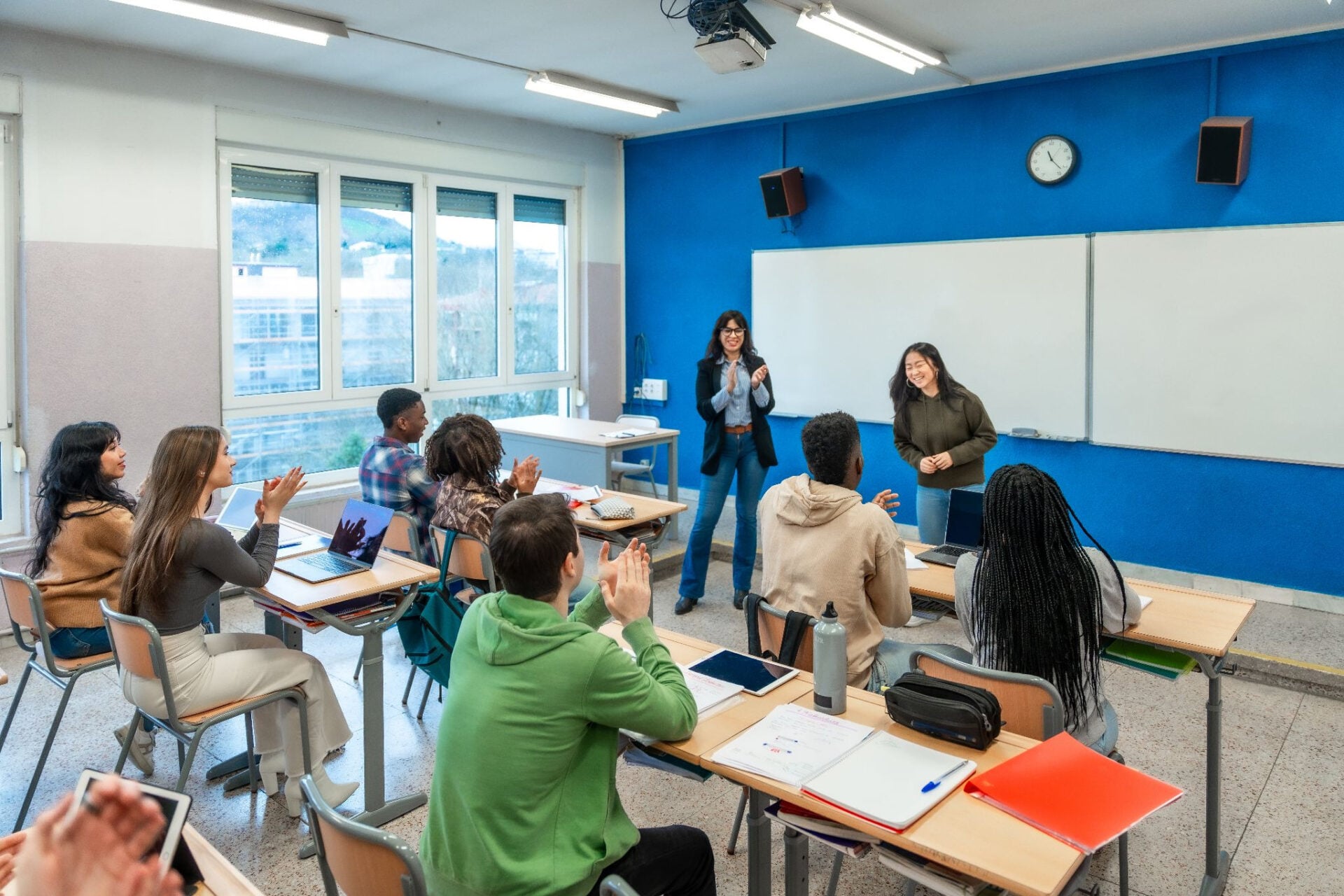
The vision for AI-powered education is bold: imagine every student having a 24/7 personal tutor that adapts to their needs. Learning is fully personalized, adaptive to each student’s pace, and powerfully engaging, like a great interactive game or story.
So what are the implications of this emergence of AI tutors? We’ll explore the pros and cons.
The need for AI tutors
Education today faces major challenges. Traditional school teaching models rely on a one-size-fits-all approach. The reason is simple: In classrooms with 20-30 students per teacher, personalized attention is difficult. However, the model leaves some learners behind while others aren’t sufficiently challenged. Kristen DiCerbo of Khan Academy puts it this way: Students “all need different things to move forward.”
The good news is that AI tutors can bridge this gap by providing real-time, personalized learning experiences. Unlike traditional e-learning platforms, AI can easily adapt to individual needs, which helps every student receive the right level of challenge and support.
Simply put, AI tutors offer tailored instruction that can make learning more engaging and accessible.
How AI tutors personalize learning
Artificial intelligence tutors are revolutionizing education through AI-driven customization that adjusts to each student’s gifts and challenges. Here are a handful of real-world examples that illustrate how AI tutors achieve this personalization:
- Real-time adaptation: AI tutors dynamically adjust to a student’s learning pace, strengths, and weaknesses. For instance, if a student excels in a topic, the AI introduces more advanced material; if the student struggles, it reinforces foundational concepts.
A case in point is Quizlet, a digital learning platform that employs AI-driven adaptive learning techniques. By tracking user progress, Quizlet’s AI suggests personalized study sets. It adjusts difficulty levels and recommends review sessions to reinforce weaker areas, which helps with retention and learning efficiency.

- Customized learning paths: AI tutors create individualized learning journeys by breaking subjects into microlearning modules tailored to each learner’s progress.
For example, Cognii, an AI-based educational tool, uses natural language processing to offer personalized tutoring. It tailors concept explanations based on a student’s responses by identifying specific knowledge gaps and offering customized explanations.
- Instant feedback & assessment: Traditional grading is time-consuming and often delays feedback. AI tutors don’t have that problem; their responses are immediate.
Grammarly, an AI-powered writing assistant, exemplifies this by offering real-time feedback on grammar, style, and clarity. It helps students refine their writing by instantly suggesting improvements. This is an interactive learning process that strengthens language proficiency.
- Virtual classrooms & immersive learning: AI tutoring programs have the ability to transform education by creating interactive and immersive experiences.
Consider Immerse, a virtual reality language-learning platform, that offers AI-powered conversation simulations. These immersive environments let learners practice real-life dialogues in virtual reality settings. This helps them become more fluent by practicing real-world conversations, such as ordering food at a restaurant or asking for directions in a new city.
The potential of AI tutors to personalize education is extraordinary. There is no doubt that these “professor bots” have the power to transform learning into a more adaptive, responsive, and engaging experience.
Unlike human teachers with limited time on their hands, an AI tutor can give one-on-one attention to every learner simultaneously. It can identify when you’re confused on a topic and provide a new explanation or set up some extra practice right away.
Meet Fred, AI tutor (think study buddy)
Ava is a tenth-grade student. She uses Fred, an AI-powered tutor, to improve her math and coding skills. Accessible through her laptop, phone, and smart speaker, Fred provides her with lessons that adjust to her skill level and learning pace.
Fred seamlessly fits into Ava’s daily routine—whether it’s quizzing her on algebra while she gets ready for school, helping her demystify English grammar during an afternoon study session, or giving her a quick refresher on geometry while she brushes her teeth before bed.
Morning with Fred, the algebra coach
As Ava rides the bus to school, she opens Fred on her phone. “Morning, Ava! Let’s crush those quadratics before first period!” Fred declares in his upper-crust British accent. The AI tutor then suggests a five-minute review of quadratic equations, a topic she struggled with last night.

Fred provides targeted practice problems and offers gentle hints when needed. When Ava gets an answer right, Fred rewards her with a digital badge—a small game-like encouragement that makes learning feel rewarding.
At school, Fred is Ava’s real-time learning assistant
In history class, Ava discreetly asks Fred through her smart earbud for a clarification on a historical date. Acting as an on-demand research assistant, the AI quickly provides an answer.
Later, during math, Ava encounters a difficult problem. Instead of feeling embarrassed to ask the teacher, she turns to Fred. Rather than just giving the solution, the AI engages her in a Socratic dialogue: “What do you think is the first step here?” This nudges Ava toward the answer while strengthening her confidence.
Fred is also synced with the school’s learning management system. This guarantees that its guidance aligns with Ava’s curriculum. It’s like having a private tutor for each student, while the teacher leads the overall lesson.
Personalized at-home study session with Fred
Back at home, Ava switches to coding practice. Knowing she’s a visual learner, Fred uses animations to illustrate Python loops. This makes the concept more tangible to Ava. The AI curates additional resources from online learning platforms, which broaden Ava’s understanding of the topic.
When Ava makes an “off-by-one” error in her code, Fred highlights the mistake. He prompts her with a question to guide her toward a solution. This interactive feedback helps Ava improve both her coding skills and debugging confidence.
Recognizing a pattern in her errors, Fred adjusts Ava’s future study plan by adding a short coding refresher. This constant adaptation keeps her learning effective and engaging.
Immersive learning instead of homework drudgery
In the evening, as Ava reviews for an English quiz, Fred shifts into a game-based approach. He plays a quick identification game on sentence structures, where correct answers trigger additional insights (e.g., “A complex sentence contains an independent clause and at least one dependent clause”). When Ava struggles with distinguishing restrictive and nonrestrictive clauses, the AI presents side-by-side examples with color-coded highlights.
To clarify the difference, Fred highlights a restrictive clause in purple: “The book that she borrowed from the library was overdue.” He explains that this clause is essential to the meaning of the sentence, so it doesn’t require commas. Then, he highlights a nonrestrictive clause in blue: “The book, which she borrowed from the library, was overdue.”
This time, he points out that the clause is extra information, so it’s set off with commas. Seeing the color-coded contrasts makes the distinction click for Ava.
This dynamic, interactive approach keeps Ava engaged beyond her intended study time, and transforms the task of editing text into a compelling experience rather than a homework chore.
Fred, the learning sidekick: always adapting, never overbearing
Fred tracks Ava’s progress—not in a creepy, surveillance-like way that feels like Big Brother, but as a friendly sidekick who is refining her personalized learning path. After noting her strengths in math and her struggles with English grammar, the AI tweaks her schedule to include extra grammar practice the next day while introducing a fun new sentence structure challenge.
Fred also helps Ava’s teachers by highlighting where she excels, as well as where she needs support. But it’s not just about school—Fred adapts to Ava’s natural learning rhythms. It knows she crushes analytical subjects in the morning and thrives on creative tasks at night, so it structures her schedule accordingly.
If she skips a study session, no problem—Fred smoothly reschedules it without overwhelming her. On weekends, the AI even shifts into “curiosity mode” by asking Ava what she wants to explore—maybe astronomy, maybe guitar—and offering fun ways to dive in.
The nature of learning with Fred: smart, seamless, and seriously fun
By the end of the school year, Ava isn’t just getting better grades—she’s more confident, more curious, and more motivated to learn. With Fred as her ever-patient tutor, learning no longer feels like a chore but more like a game, a challenge, and even an adventure.
The best part? This new type of education isn’t limited to classrooms or textbooks. Instead, it’s a personalized, interactive experience woven into everyday life—on the bus, at home, and even while standing in front of the bathroom mirror.

Whether Ava wants to learn French, compose music, or crack the mysteries of quantum physics, Fred is right there breaking it down into bite-sized, doable steps.
This isn’t just learning. This is learning leveled up.
What are the downsides of AI tutor-driven learning?
But what about the cons of AI tutoring? Surely there are some. Does AI, used in this manner, replace critically important social interactions among students, and with teachers too?
What about excessive screen time? That can’t be healthy either, can it?
These questions deserve serious consideration and equally serious answers.
- Impact on social interactions: There is no doubt that increased use of AI in education affects student interactions with peers and teachers. The question is how and to what extent.
One National Institutes of Health study indicates that over-reliance on AI has the potential to diminish interpersonal skills and emotional intelligence, and can even lead to social isolation and anxiety. AI’s role in education might negatively impact adolescents’ social adaptability and family support.
- Excessive screen time: AI-driven learning often requires extended use of digital devices. This raises the obvious concern of excessive screen time.
It is true that research has linked prolonged screen exposure to various negative outcomes in youth, including reduced attention spans, less creativity, and mental health issues. Moreover, excessive screen time has been associated with higher rates of obsessive-compulsive disorder diagnoses and difficulties in self-soothing among children and adolescents.
These are significant cautionary findings that deserve continuing study, as well as proven, well-developed remedial strategies and tactics.
What are some strategies to mitigate AI challenges?
There are several approaches to address these issues that center on AI danger and risk in the field of education. Here is a sampling:
- Balanced integration of AI tutors: Combining AI tools such as machine tutors with traditional teaching methods can help maintain essential human interactions in educational settings.
- Screen time management: Implementing AI-based interventions, such as visual and audible alerts, can encourage students to take breaks and engage in offline activities, thereby reducing continuous screen exposure.
- Educator involvement: Teachers can use AI to handle administrative tasks. This can free up time for more direct engagement with students, which can help with establishing stronger, more personal teacher-student relationships.
By thoughtfully integrating AI into education and being mindful of these and other potential downsides, it is possible to harness the benefits of the technology while not losing sight of the critical social aspects of classroom learning.
Ethical considerations of AI in education
While the potential of AI in education is exciting, it also brings important ethical questions that society must address. To fully reap the benefits of AI tutors, we need to be mindful of issues like data privacy, bias, and the evolving role of teachers. Some key considerations:
Data privacy and security: keeping AI tutors safe and ethical
AI tutors personalize learning by collecting student data—from quiz scores to time spent on questions, and possibly even sensitive details like learning disabilities or emotional cues. This raises serious privacy concerns.
There must be strong security measures in place to protect student data, and parents and students should have complete transparency and control over what’s collected.

Ownership is another issue: does the data that’s being collected belong to students, schools, or EdTech companies? Privacy laws in various countries provide some guidelines for safeguarding student information, but these regulations must evolve alongside the technology. Simply put, AI should help students, not spy on them.
AI bias and accessibility: problems and solutions
AI tutors are only as good as their data and design. Without careful development, they risk reinforcing biases or excluding certain students. Education should empower students with knowledge and critical thinking, not subtly push a particular worldview.
If an AI tutor skews its examples, recommended readings, or explanations toward any political, cultural, or social ideology, it risks shaping learning in an unbalanced way rather than stimulating open inquiry and critical thinking.
Accessibility is equally vital. AI tools should support screen readers, captions, and alternative navigation for students with disabilities.
Ethical AI should be transparent. Ongoing monitoring, user feedback, and diverse development teams are key to making sure that AI in education serves as an equalizer, not a barrier.
Teacher-AI collaboration: a powerful partnership
A common fear is that AI tutors might replace teachers, but the reality is that AI is designed to enhance, not eliminate, human instruction. While AI can automate tasks like grading or answering routine questions, teachers provide irreplaceable value—mentorship, emotional support, and the ability to understand nuances in the student’s learning and behavior that AI cannot.
The emerging consensus is that AI should be a tool assisting teachers, not a substitute. In practice, this means shifting teachers’ roles to focusing on higher-level guidance. AI can handle repetitive tasks like drilling practice problems, while teachers use AI-generated insights to personalize the instruction.
For example, instead of grading every quiz, a teacher can spend more time mentoring students and teach creative problem solving. To accommodate this, teachers will need excellent training to effectively integrate AI into the classroom and to fully understand its strengths and its limitations.
The AI itself should be transparent and clear about its role and not encourage over-reliance. If implemented thoughtfully and observed carefully, AI can free teachers to do what they do best—engage, inspire, and shape students into lifelong learners.
The future of AI-powered learning
AI tutors represent the next major leap in education by offering truly personalized learning that adapts to each student’s needs. They can provide customized learning paths, real-time feedback, and immersive experiences that make education more engaging and effective.
The future of AI in education is not about replacing teachers but helping them better reach and support every student. By carefully including AI tutors as a key education tool, learning can become more accessible, dynamic, and focused on individual success.
The idea is that the classroom of tomorrow will be one where students don’t just absorb information—they interact with it, guided by AI tutors that understand their learning journey better than any textbook ever could.
Yes, we must take great caution to avoid the AI dangers noted above. But if handled with care, the potential benefits of this technology can be great.

Leave a Reply