

In places as different as Finland, Australia, and Chile, new homelessness solutions are emerging. They represent a successful shift away from crisis-based shelters and toward lasting housing solutions.
Some countries do this through formal “housing first” programs. Others achieve it through grassroots volunteerism or long-term support systems. But all reflect a growing belief that secure housing should be the starting point of stability, not something earned after meeting certain conditions.

Some of the most successful efforts share a core philosophy: provide stable housing first, then offer the support people need to rebuild their lives. This approach, known as Housing First, is proving far more effective than traditional models built around conditional aid.
But before exploring approaches that work, it’s worth understanding the scale of the challenge.
How many people are homeless?
The answer is staggering. Globally, more than 330 million people lack access to adequate shelter, according to the United Nations Educational, Scientific and Cultural Organization (UNESCO). In the United States alone, over 650,000 people are homeless on any given night.
These figures can imbue a sense that the homelessness problem is too vast, too hopeless, too complex, to be truly solved.
However, there’s growing evidence collected from around the world that homelessness is preventable and solvable. In fact, some countries and communities have dramatically reduced it. Their secret? Shifting from reactive, short-term shelter solutions to long-term, housing-first strategies rooted in coordinated and closely tracked support systems.
Housing First is a radically practical approach to homelessness. It is simple in concept but profound in impact. It starts with a counterintuitive idea that’s proven to work: provide people experiencing homelessness with permanent housing immediately, without requiring sobriety, employment, or participation in treatment programs.
Why is this radical and practical?
Because it’s a radical but proven idea: that unconditionally giving someone a stable home first almost always creates the strongest possible foundation for recovery, employment, and dignity. Without the constant stress of finding a place to sleep or store belongings, individuals are far more likely to access healthcare, find employment, and engage with supportive services.
Housing First doesn’t ignore deeper issues underlying homelessness, such as addictions to drugs or alcohol. Instead, it simply recognizes that lasting progress in life is extraordinarily difficult without a safe, stable place to live.
The paradigm shift is this: rather than making housing conditional on personal transformation, the Housing First model uses housing as the platform from which transformation becomes possible.
The Housing First model vs. traditional “treatment first” approaches
The traditional model, often referred to as “treatment first,” withholds housing until people meet certain conditions. Housing First flips this approach. It recognizes that stable housing is the foundation from which individuals can address mental health, addiction, employment, and social reintegration.
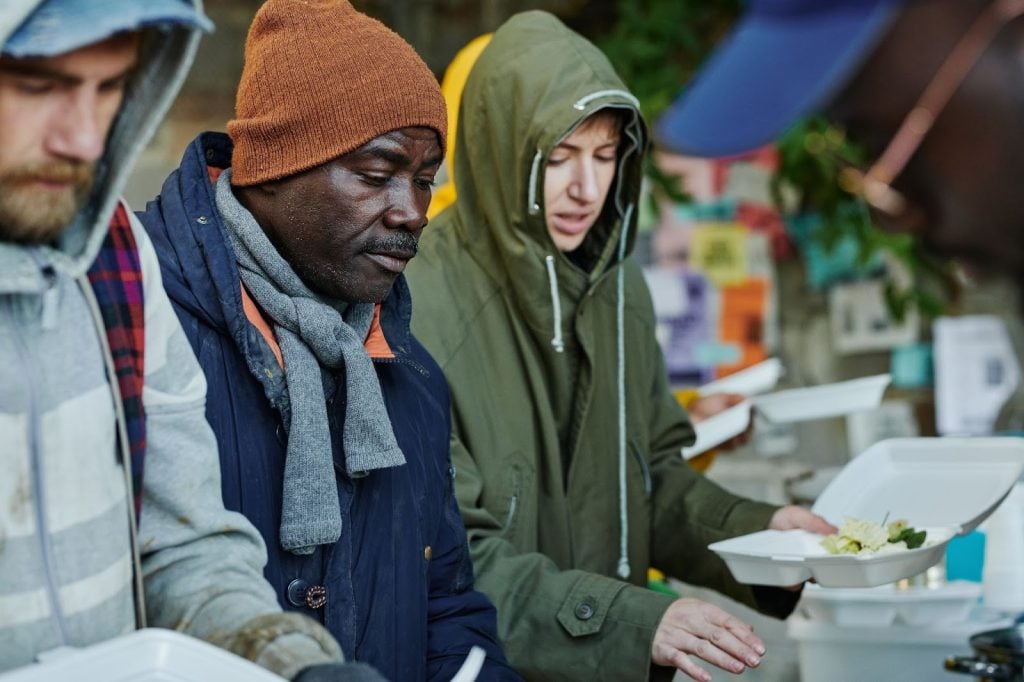
In this model, supportive services are still just as essential. But they follow, rather than precede, housing. Assistance beyond finding housing for an individual or a family could include counseling, job training, or access to health services, each element of care tailored to a resident’s needs.
This approach has been adopted in countries across Europe, North and South America, and beyond. The results are compelling. In many places, it has reduced chronic homelessness, cut public service costs, and restored the lives of those trapped in cycles of hopelessness.
But how does Housing First work in practice? The next four case studies offer some clear answers.
Inside Finland’s homelessness solutions
In Finland, homelessness has declined by more than 80% over the past two decades. Today in Finland, street homelessness is virtually nonexistent. The country’s success stems from a bold national commitment to the belief that housing is a basic human right.
Whether or not that value resonates with our personal beliefs, there’s no denying that Finland’s approach to homelessness has produced some impressive results.
A national strategy built on housing, not shelters
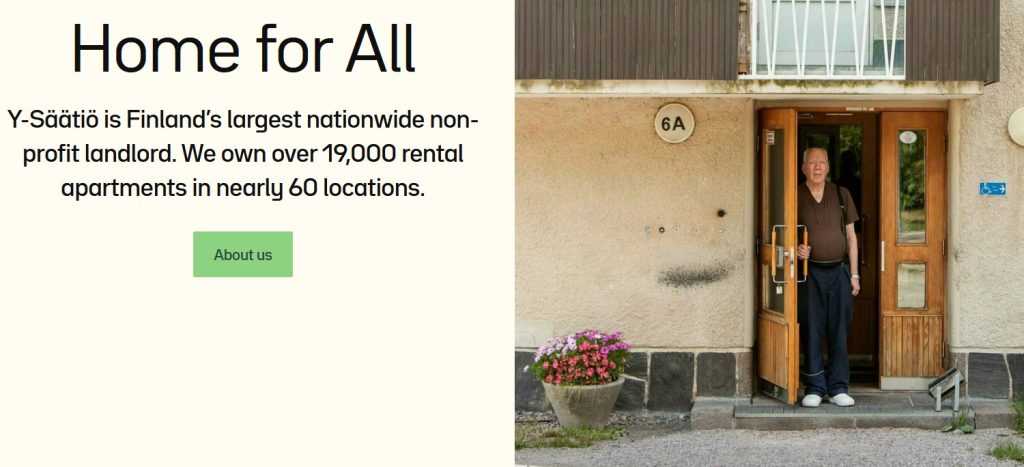
Launched in 2007, Finland’s Housing First strategy replaced short-term emergency shelters with permanent housing units. Many of these are owned and managed by the Y-Foundation, a nonprofit social housing provider and one of the largest landlords in Finland.
Founded in 1985, the Y-Foundation focuses specifically on providing affordable, long-term rental housing to people experiencing or at risk of homelessness.
Here’s how it works. Rather than clustering housing units for homeless people in large complexes, the foundation acquires apartments in regular residential buildings across cities and towns. This scattered-site housing model places tenants in ordinary neighborhoods to promote social integration—an approach that helps reduce the stigma of homelessness and the burden of social isolation among the residents.
How the Y-Foundation funds its operations
The Y-Foundation receives its funding from multiple sources. It uses low-interest loans from the Finnish state, particularly through the Housing Finance and Development Centre of Finland.
It also collaborates with municipalities that co-finance housing solutions. Rental income from tenants, most of whom pay a portion of the rent based on their income, contributes to the foundation’s operating budget as well.
Housing first, then other support services follow
While housing is its central focus, the Y-Foundation works closely with municipalities and social service providers to make sure that tenants also have access to the support they need.
In this way, the foundation plays a pivotal role in implementing the nation’s Housing First strategy—not just as a landlord, but as a long-term housing partner committed to ending homelessness.
Once housed, individuals receive support services tailored to their needs, including mental health treatment, addiction treatment and substance use counseling, budgeting help, and job coaching. Case workers conduct regular visits and build trusting relationships over time, acting as a bridge between residents and the broader health and social service systems.
Rent is typically income-based and subsidized to keep it affordable. Participants sign standard lease agreements, just like anyone else. Both these formalities and paying rent reinforce a sense of dignity and accountability. In addition, if participants fall behind on their rent or encounter setbacks, the focus is on problem-solving, not on eviction.
The program works because the support doesn’t disappear once someone is housed. Instead, housing acts as the foundation for long-term recovery, social reintegration, and, in many cases, eventual independence.
Beyond crisis care: how Australia combats homelessness
While Finland is widely recognized for pioneering Housing First at the national level, Australia has developed a parallel model that shares key principles—particularly long-term housing stability—while adapting them to local needs and systems.
Australia has built one of the most structured nation-level responses to homelessness in the world. It balances immediate relief with long-term housing stability.
The country tracks homelessness across three tiers:
- Primary homelessness: People sleeping on the streets or outdoors, commonly called “sleeping rough” in Australia.
- Secondary homelessness: Those in temporary shelters or couch surfing.
- Tertiary homelessness: Individuals living in insecure or substandard housing without secure rental agreements.
This classification system allows authorities and agencies to respond in a nuanced way to homelessness and housing needs.
How Australia changed its approach to homelessness
In 2009, Australia undertook a national overhaul of its homelessness services.
The government replaced the long-running Supported Accommodation Assistance Program—which primarily focused on crisis intervention—with a more coordinated and future-oriented system known as Specialist Homelessness Services (SHS).
Under SHS, services moved away from stopgap sheltering of people without homes and toward a client-centered model built on three pillars:
- Transitional housing to offer immediate stability
- Individualized case management to address the root causes of homelessness
- Integrated partnerships across housing, health, and social services

Instead of viewing homelessness as an emergency to be contained, SHS framed it as a solvable condition that requires sustained and comprehensive support.
Case managers work closely with clients to set achievable goals. They connect them to income support, mental health care, and addiction services, and eventually guide them into long-term, secure housing options.
What makes Australia’s approach work
To make this system work at scale, Australia has backed it with stable federal-state funding agreements so these critical housing services will not be interrupted by budget shifts. Consequently, agencies in both urban and rural communities feel supported in their efforts to implement SHS according to their local needs.
A key element has been a national reporting framework that tracks service delivery and client outcomes in real time. This data guides the program’s funding and keeps providers accountable for long-term success.
Today, in a nation of 28 million, more than 100,000 people per year receive support through SHS. That includes a strong focus on serving women and children fleeing from domestic violence who are particularly at risk of becoming trapped in cycles of homelessness.
Unlike emergency shelter systems that essentially reset every night, Australia’s approach helps people reset their whole lives. The results—and the replicable model—are now drawing global attention.
Latin America: a community-led housing model
Across Latin America, where formal housing systems often fall short and public infrastructure is strained, a grassroots movement has emerged that redefines what’s possible through collective action.
TECHO—Spanish for “roof”—is a nonprofit organization that mobilizes thousands of young volunteers to build transitional housing units, known as mediaguas, in informal settlements throughout the region.
Founded in Chile in 1997 and now active in 19 Latin American countries, TECHO has built more than 100,000 shelters. The organization offers rapid relief to families living in extreme poverty.
It operates through a decentralized structure, with local offices in each country staffed by a mix of paid professionals and volunteers. Funding comes from a range of sources, including private donations, corporate sponsorships, and partnerships with governments and international NGOs.
TECHO’s approach is unique in its blend of urgency and community ownership. Temporary wooden homes are constructed in just a few days, using low-cost materials and local labor, often for just $1,000–$2,000 per unit. That is a cost-effective model that’s scalable even in low-income nations.
From crisis to community: how TECHO builds more than shelters
TECHO’s impact extends beyond the physical structure. The organization works alongside residents to develop community-based solutions in areas like education, clean water, sanitation, and legal housing rights. Volunteers don’t just build homes. They listen, collaborate, and help lay the groundwork for self-managed housing efforts led by the community itself.
Though not formally a Housing First model, TECHO reflects some of its core principles. Like Housing First, it challenges the notion that people must meet certain conditions before being deemed worthy of housing. And like Australia’s SHS, it recognizes that dignity and stability come first, even if the first step is a small, temporary home.
Though not a religious organization and welcoming volunteers from all backgrounds, TECHO draws from timeless Catholic values: compassion for the poor, mercy in action, and a selfless commitment to serve “the least of these.”
When housing leads, quality of life follows
The creative efforts to end the homelessness problem that are unfolding in Finland, Australia, and across Latin America reveal a powerful truth: homelessness is not an unsolvable tragedy. It’s a social challenge with proven solutions when we lead with housing, build trusted systems of support, and treat every person as worthy of dignity from the start.
The models we profiled are different in structure, culture, and scope. Yet all share a common starting point: a refusal to accept homelessness as inevitable.
The models and the agencies and organizations that administer them are investing not just in programs but in people. These models replace emergency responses with enduring partnerships between governments, nonprofits, case workers, volunteers, and the communities they serve.
The lesson is clear: a future without homelessness isn’t just a dream. In many places, it’s already a reality in motion.
One response to “Homelessness Solutions around the World”
-
What a great read. Thank you!


Leave a Reply