
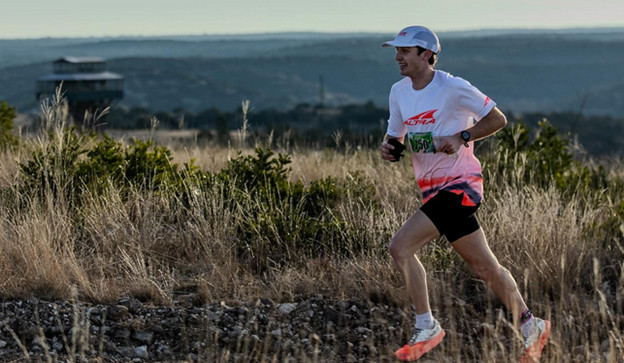

The legendary Western States Endurance Run, a 100-mile mountain ultramarathon from Olympic Valley to Auburn, California, climbs through snowy alpine passes and drops into sun-scorched canyons. It is a demanding 18,000 feet of ascent and an even more punishing descent.
This grueling race has tested many great runners, but one rookie runner encountered its deepest lessons before even reaching the starting line.

For ultrarunner Hans Troyer, the most important life lessons came not on the trails of the High Sierra but in a desert hospital. There, his body swollen with fluid, his kidneys ravaged by rhabdo after he refused to quit a race he had no business finishing, he came to a quiet realization: the race he most needed to finish wasn’t on a trail, but within himself.
Unlike the calm of meditation or the contemplative stillness of yoga, Hans’s path to spiritual awakening came through collapse, surrender, and searing physical pain. In just over a year, a young man living in a camper in Newnan, Georgia, had rocketed from total obscurity to earning a coveted Golden Ticket into what is widely regarded as the most iconic ultramarathon in the world.
Along the way, he shattered records, flirted with death, and most importantly, began a personal transformation far deeper than physical training could ever reach.
But Hans’s transformation wasn’t only spiritual. It was also physiological. After collapsing at the Black Canyon 100k from rhabdo and nearly losing his life, Hans also overhauled his nutrition. Gone was his junk food diet. With guidance from ultrarunner Emory Atterberry, he began testing a new supplement called HyperLyte, a runner’s formula designed to simplify race-day fueling.
In a sport where hydration and nutrition can mean the difference between finishing strong and collapsing, this shift became a turning point. As Hans’s spiritual awakening deepened, so too did his commitment to caring for the body that carried him.
What began as a brash charge toward greatness turned into something else entirely: a spiritual reckoning disguised as a race. In The Kid: Ultrarunning’s Phenom Hans Troyer, a poignant documentary chronicling his rise, we witness the unmaking and remaking of a runner who had to be humbled before he could truly endure.
The kid who flew too close to the sun
It started at the Bandera 100k ultramarathon, run on a rugged Texas course known for getting the best of even the most elite runners.

On January 13, 2024, veteran ultrarunner Emory Atterberry was casually tracking Bandera’s live feed when a name he didn’t recognize flashed across the race’s leaderboard.
“There was this guy just absolutely sending it,” Emory recalls in The Kid. “Running with what looked like reckless abandon, with no one in sight.” The mystery runner had blasted through the 50k halfway point in 3 hours and 46 minutes and was on pace to crush ultrarunning legend Jim Walmsley’s thought-to-be-untouchable course record.
That runner was Hans Troyer. He was 23, unknown, and unapologetically bold. His Strava post the day before the race read: Get Wrecked Jim.
“You don’t talk to the GOAT (Greatest Of All Time) like that,” says Jeremy Bohnett, another veteran ultrarunner. “Nobody speaks to Mr. Walmsley like that.”
But Troyer backed it up. He crossed the finish line in 7 hours, 45 minutes, which obliterated Walmsley’s time. He became the first runner besides Walmsley to break the eight-hour barrier at Bandera.
“That alone would’ve been legendary,” Jeremy noted. “But what came next…that’s what made Hans unforgettable.”
The reckoning: Black Canyon’s brutal lesson in grit and grace
Barely a month after his record-setting debut, Troyer showed up at the starting line of the Black Canyon 100k in Arizona, this time toeing the line with elite runners including Hayden Hawks. For 40 miles, he traded leads with Hawks. Then his body buckled.
THE BLACK CANYON 100K

“My kidneys started shutting down,” Troyer recounts. “I had no idea what was happening at the time—I just knew something was really wrong.”
Nevertheless, he kept running, for 20 more miles. Through searing pain, dehydration, and near-organ failure, he refused to quit. He finished in tenth place, deeply disappointed in himself. Then he collapsed.
“Hans finished strong with 20 miles of pure suffering from rhabdo,” Jeremy said. “That was the moment I realized this kid is special. He’s built different.”
The cost of refusing to break—and the awakening that followed
It wasn’t until afterward that the severity of the situation became clear. Hans hadn’t urinated once during the race. When he mentioned this to his wife Grace while they were driving away from the course, she immediately turned the car around and rushed him back to the event’s medical tent.
From there, he was transferred to a hospital. His urine was coke-colored, and his bloodwork showed a creatine kinase (CK) level above 47,000. That’s a medical marker of extreme muscle breakdown. Healthy levels typically range from 30 to 200.
Hans spent 12 days in the hospital, swollen with fluid, his lungs struggling to drain, his body teetering on the edge of shutdown. “If I never went to the hospital, I probably would not have made it,” he said afterwards.
“I thought I was invincible,” Hans admits in the film. “I’d never really been hurt before. I didn’t think anything could touch me.”
But something did. And in that near-death moment, his being cracked open.
His brother Jeremiah told him plainly: “You actually have a more powerful mind than body.”
That realization marked the beginning of a deeper kind of endurance, one rooted in soul growth rather than physical strength. “It was kind of a life-or-death situation,” Hans reflects. “But I wasn’t afraid. I trusted that God had a plan, even if it meant going back to the hospital, or worse.”
The turning point: surrender, not defeat
The near-death experience at Black Canyon didn’t just slow Hans down. It altered his trajectory. For the first time in his life, the runner who thought nothing could hurt him was forced to confront a simple truth: he wasn’t indestructible.
The kid who once joked he’d walk away from a plane crash when no one else did had just barely made it out of the hospital alive. But what emerged from that reckoning wasn’t defeat. It was a spiritual awakening.
“I spent a lot of time praying that week,” Hans recalls in the film. “I said over and over, ‘God, I trust you.’”
The bravado that had once fueled Hans was slowly being replaced by something quieter but stronger: trust. His path was no longer about competition, though he still loves to win. Now it was about personal growth and surrender to God.
He began to think differently about what endurance really meant. “I’m not defined by this sport,” he says in the film, his voice soft but sure.
His father, David Troyer, saw the shift unfolding and knew exactly what it reminded him of. He pointed to Chariots of Fire, the 1981 film about two Olympic runners—one driven by the need to prove himself to the world, the other compelled by a sense of divine calling.
“There’s this moment in the film,” David explains, “where one of the runners says, ‘I have ten seconds to justify my existence.’ That was his reason for running. But the other runner, Eric Liddell, says something different: ‘When I run, I feel His [God’s] pleasure.’ That line always stayed with me.
“And when I saw Hans go through what he did and come out the other side, I knew. He wasn’t running to justify anything anymore. He was running because he was made to. Because it brought him closer to something sacred.”
The comeback: the Canyons 100k and the long-shot miracle
Hans’s first chance to punch a ticket to the Western States Endurance Run came at the Black Canyon 100k in the Sonoran Desert of Arizona in February 2025, exactly one year after the race that nearly killed him.
It was a symbolic return to the scene of his collapse. But the night before the race, he texted Emory and Jeremy that he had to drop out of the race because he was quite sick.
Hans also was battling mind issues. “I was having a bit of a mental breakdown,” he admitted in the film. “I’d prayed all week, ‘God, whatever your will is, I trust it.’”
With Black Canyon in the rear-view mirror, Hans had just one final shot left at a Golden Ticket: the Canyons 100k Endurance Run, held in Auburn, California. By that time, Hans had dropped off the radar of race favorites. Media coverage leading up to the race didn’t even mention him.
But this time, there was no illness, no hesitation, and no fallback plan. It was all or nothing.
And he ran like it.
Hans surged through the course, passed seasoned elite runners, and held his position in a brutally competitive field. By the end of the race, he had done what few believed possible: finishing second. As one of the top three finishers, this earned him his Golden Ticket and a place on the starting line at Western States.
At the finish line, overwhelmed and exhausted, he collapsed into Grace’s arms.
“Praise God, man,” he said through tears. “We made it.”
Western States: the start line that almost wasn’t
On June 28, 2025, fifteen months after his first ultramarathon, Hans Troyer stood on the starting line of the Western States 100, the most prestigious trail race in the world.

In a field stacked with legends like Walmsley, Kilian Jornet, and Adam Peterman, Hans was still the newcomer. The rookie. But this time, he wasn’t there to prove anything.
“I’ve already been tested,” he said before the race. “This is just the reward.”
The heat was brutal, the climbs relentless, the canyons unforgiving. But Hans moved through it all with quiet steadiness, a far cry from the cocky upstart who once taunted the GOAT with an online post. He didn’t chase the front. He ran his race—honest, patient, and grounded.
He crossed the finish line with hands raised and face lit up. Not first, but a top ten finish. Not broken, but whole.
Western States 100-mile Endurance Race – 2025

The race he was born to run
There’s a moment in The Kid, just after Hans crosses the finish at Canyons 100k, where he looks into the camera and says, “As Kobe [Bryant] said, ‘it’s about the journey, not the destination.’”
Coming from anyone else, it might sound cliché. But from Hans, it feels earned.
He didn’t just earn a spot at Western States. He earned a new way of being, one shaped by surrender, not striving. A kind of freedom that only emerges after a spiritual trial. A grit forged through suffering. An awakening that no podium could ever provide.
It turns out the race he was born to run had little to do with beating records or claiming titles.
It was always about something deeper: learning not to run for glory, but for grace.

Leave a Reply